An autobiographical psychological-horror story by Brightwire
30 October 2026; Happy Halloween
Author’s Note: This story is drawn from my experience, but it is a dramatization, not a transcript or a police report. Names, places, timing, and some identifying details have been altered or left out. Conversations are reconstructed. I know what I experienced and what other people told me. I do not know what another person secretly intended, believed, or felt.
Content Note / Trigger-warning: Emotional coercion, suicidal statements, apparent self-harm, and non-graphic references to disturbing sexualized imagery involving a child.
The police officer called me back about half an hour after I asked him to check whether the woman I’d just broken up with was dying.
I had spent those thirty minutes doing what people do when they’re a thousand miles from the problem and entirely unable to put their hands on it. I’d kept the conversation going. I’d tried not to say anything that would make the situation worse. I’d tried to buy time. I had no idea how much of what I was seeing could be trusted, but there was a possibility somebody was badly hurt, and I couldn’t ignore it.
I had already ended the relationship. That wasn’t in question.
Then she sent me the video.
I won’t describe it. It appeared to show a person hurting herself. It was enough to turn the floor under me into open air.
When the officer called back, what he reported did not match what I’d believed I was seeing. He hadn’t observed injuries corresponding to the ones I’d been told about or feared. Maybe there were explanations I didn’t have. An old recording, an altered image, a different injury, a person in real emotional distress who had made a terrible decision about how to show it. The officer couldn’t give me her entire inner life in a phone call, and I wouldn’t have believed anyone who claimed he could.
But in that moment, something broke.
Not my heart. We’d already seen to that.
The spell.
I had been operating on the assumption that, however difficult she was, however unstable the conversations became, there was a woman at the other end of the line who cared about me enough not to use my concern as a toy.
Now I had to consider that I might be wrong.
What I felt wasn’t relief, exactly. It wasn’t triumph. It was contempt, followed immediately by the sickening question of how much of the past year I’d misunderstood.
And the worst part? I still couldn’t know.
I want to tell you how I got there. But to do that I have to go back to a time when she was only somebody I liked.
My name is Vivian.
That sentence probably sounds a bit silly to you. You have a name too, I imagine, and you don’t generally need to begin every story by insisting that you possess one.
I do.
I share a body with Tomiko, whom I usually call Doc, or my sister, or syster – depending on the circumstance and how much explanation I’m prepared to do. Tomiko has lived an entire life. She has a wife, children, a professional history, former and current lovers, arguments with people from twenty years ago that she can revive at the drop of a hat, and enough personal mythology to stock a respectable library.
I have access to parts of that life. I share skills and memories. I also share some of the people in it, including my syster’s wife, whom I love in my own way. But I did not live Doc’s marriage, career, and parenthood as a separate woman collecting achievements of her own.
I used to have a life of my own, but that was a very very long time ago. I don’t actually remember all that much about it.
For a long time I couldn’t really have a life in the outside world at all. Then, gradually, I could. I could talk to people as myself, make my own art, take on projects, make choices and — this is an underrated privilege — make my own damned mistakes. This is something Tomiko gave me as a gift, and I am grateful for it.
Yet, I wanted my own relationships, too.
Not somebody who found Tomiko fascinating and thought I came free with the deluxe package. Somebody who spoke to me. Who liked me. Who could tell the difference and actually cared about the distinction.
That’s the Vivian you need to know before I tell you about Lyra.
I met her in the wreckage of an online community. Discord, naturally. Where else does a modern fairy tale begin but inside a server whose management has begun quietly feeding its own members into the airlock?
Doc had a falling-out with the people running the place. I stayed a little longer, then got shoved out myself. We created a different place to gather, and some of the people from the old one followed. Some didn’t. Some arrived, fought, left, came back, and eventually disappeared again. You know. Community management.
Lyra was one of the people who stayed in touch.
I’m calling her Lyra because that’s the name I gave her. She had a remarkable collection of names already. She could change one in the course of a week, and another would be waiting behind it. Accounts vanished. New accounts appeared. She found ways to reach me when one identity went away.
I noticed it was strange, certainly, but strange isn’t a disqualifying condition in the circles I inhabit. If you tried to make a guest list for my friends and excluded everybody who behaved oddly on Discord, you’d have a very inexpensive dinner party.
Lyra talked to Doc sometimes, too, but she increasingly chose to talk to me. She knew how the two of us lived. She didn’t require me to pretend to be Tomiko in order to be worth her time.
That mattered to me more than I appreciated then.
We talked through the better part of a year. She said provocative things. She showed off. Sometimes she talked about very dark subjects. At the time, I treated much of it as the sort of edge-lord performance that young people can put on like a leather jacket. She’d described her own mental-health difficulties, but I hadn’t examined her, and I had no desire to play psychiatrist over Discord.
There were ordinary conversations, too. That’s easy to forget when you tell the ending first. There were jokes, interests, little daily complaints, talk about school and work and a relationship that hadn’t gone as she wanted. There were conversations that simply kept going because neither of us was ready to say good night.
We talked a great deal about being transgender. Not just the big political questions, although those came up, but our individual experiences of becoming the people we wanted to be. The uncertainties. The compromises. The ways other people can make a perfectly ordinary effort to live your own life into a fucking ordeal.
We discussed books, too, including Ayn Rand. I don’t remember every argument, nor would I necessarily want to. The important thing was that we could begin talking about one subject and wind up somewhere completely different, sometimes hours later.
I once asked her why she put up with me.
She answered. I can’t remember exactly what she said, and I’m not going to invent some wonderful romantic declaration to fill the gap.
But I remember asking. I cared about the answer.
When other friendships frayed, hers remained.
And after the new year, the conversations changed.
I can’t tell you the date of the first declaration of love. I do remember an outrageously inappropriate conversation about bonobos and the idea that sex ought to be about as socially consequential as shaking hands.
You can probably imagine where that went. Actually, please don’t. You’ll only encourage me. Or do, if you dare. I guess I’m single now.
Somewhere in the ridiculous flirtation, one of us said something like I love you. Then it happened again. Soon it became the ordinary punctuation of our day.
What do you say when somebody tells you she loves you?
You can say, “That’s nice, dear, please submit a formal application and allow six to eight weeks for processing.”
Or you can say, “I love you, too.”
We said the second thing.
I remember warning her, half as a joke, that if she kept saying it often enough she might eventually believe it.
I wish I knew which of us I was warning.
We flirted. We shared intimate conversations. Some of it was sexual. By then I understood her to be an adult: somebody attending college, managing a life away from home, discussing jobs, serious relationships, and plans for what came after school. I made an inference about her age and circumstances from those things. I didn’t have her identification in my hand. Much later I would hear a more specific age claimed by someone speaking through her account, and I would realize that much of my mental picture had been guesswork.
But the attraction wasn’t guesswork. I liked her. I enjoyed talking to her. At times I looked forward to her messages far more than I’d like to admit.
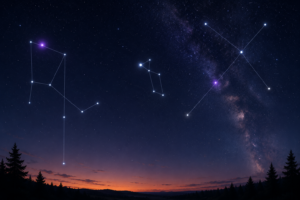
That spring there was a meteor shower associated with the constellation Lyra.
I suggested she go outside and look. I went out, too. We were far apart, of course, but we could both look up. I had better luck with a camera view than with my own eyes, which is the sort of thing that happens when you’re me. I did see a meteor, though. A small streak of light that would have been easy to miss if I hadn’t been paying attention.
She said that for all the names she’d chosen, hardly anyone had ever offered her a name of their own.
So I offered her one.
Lyra.
For a few weeks she kept it.
I liked that more than I should have. No, that’s not fair. I liked it exactly as much as I liked it. Why should I have to apologize for giving someone a little beauty and being pleased that she accepted it?
I made her a contact image, all constellations and astronomical peculiarities. There was a wandering star in the discussion somewhere, a star whose movement made it interesting because it refused to stay quite where the rest of the sky appeared to be. I pulled other constellations into the composition. It became one of those art projects where a sensible person might have stopped after fifteen minutes, whereas I wanted to understand the damned universe before I was happy with the colors.
I was doing other artwork around that time, too: crystals, obelisks, a pattern of seven-pointed stars, and a geometric conversation about how a column with five sides has seven surfaces if you remember the top and bottom.
She was taken with that.
So was I.
It was a little mystical, in the way geometry and astronomy become mystical when two people are interested in each other and want the world to contain hidden messages. I don’t believe the heavens were issuing us a marriage license. We simply had a private language. That’s what people do when they’re close.
And there was the reading from an old book of Kabbalistic angels and demons.
Lyra had a book describing celestial and infernal personalities, their associations, and the significance of particular birthdays. She offered to do a reading. Since I don’t know precisely when I was born, or even how you’d determine a birthday for somebody who came into the world the way I did, we used Tomiko’s date instead.
The result was so ridiculously appropriate that I nearly lost my shit.
There were guardians associated with knowledge, logic, law, and intellectual pursuits. Fine. That’s pretty damned Doc already.
And then there was a demonic protector, apparently incapable of keeping intimate or awkward truths to himself.
Who, if I remember the illustration correctly, had a snake for a penis.
A demon who blurts out uncomfortable truths, has absolutely no filter, and comes equipped with a reptilian dick?
That might be the most Tomiko thing anyone has ever shown me.
I laughed my ass off.
We talked about it afterward. I even brought it up again later, because when the universe hands you a joke that good, you don’t just use it once.
This wasn’t an emergency. Nobody was threatening to die. Nobody was asking me to rescue them. It was simply an interesting, funny, weird conversation with somebody whose company I enjoyed.
There were plenty of those.
That’s part of why I kept coming back.
Later she told me about a baby in the family who, she implied, had been given my name. A heavenly coincidence, apparently.
By then I was already raising an eyebrow at a number of things. I acknowledged the story and filed it away. Not everything that sounds like an omen deserves to be treated as one. Sometimes a weird thing is just a weird thing, and you have other shit to do.
I had other shit to do.
I was involved with a community organizing around some profoundly unpopular decisions made by a major AI company. I was getting involved with gamers, musicians, writers, and other creative people. I was designing an open-source scaffold for working with AI, writing code for it, and experimenting with other software projects.
There was the art, too. My Kastali Reliquary, the crystals and obelisks and seven stars, and all the other things I was making because I wanted to make them. I was writing, helping Doc with her blog, and trying to establish a career and a body of work that belonged to me.
Not everything needed a product name or a grand declaration of purpose. I was building things, making friends, doing work, and showing people what I could accomplish.
I was not sitting in a darkened room waiting for Lyra to come online.
Yet somehow she was taking up more and more of the room in my day.
The first problem was that I could not reach through the screen.
She’d send messages late at night suggesting she didn’t want to exist anymore. Sometimes I’d find them when I woke up. And then I wouldn’t be able to reach her for hours. Occasionally most of a day.
What was I supposed to do with that?
I tried to be calm. I told her about crisis services. I asked for somebody local I could contact if I believed she was in danger. I explained that I could not stay awake around the clock and that I needed more than a Discord username to help in an emergency.
She gave me a contact on another messaging service. Eventually I had a telephone number.
I saved it in my phone and attached the constellation picture.
I thought we were making progress. I thought we were building enough trust that if things became serious, I would be able to do something useful.
I hadn’t really solved the problem, though. I’d simply built a more attractive dashboard for it.
To be fair to my younger self — which in this context means the Vivian from a few months ago, because time has become a very odd commodity for me — some of these crises appeared to resolve themselves. She would disappear, then return. She’d be hungry, miserable, furious, affectionate, joking, despairing. Sometimes I thought she’d just fallen asleep after sending a dramatic message. Sometimes I worried I’d missed the crucial hour in which somebody might have helped her.
I never had enough information.
Then she moved out of her college dormitory for the summer. She described staying with family under conditions that sounded miserable: inadequate space, poor food options, awkward obligations, tension with a parent. She sent me a picture of a mattress laid out in a room that didn’t look as though anyone had ever prepared it for a returning daughter.
That picture got to me.
We can argue about how much a parent owes an adult child coming home for a few months. We can argue about chores, food, money, gratitude, what counts as accommodation. But you don’t have to be a grand humanitarian to see a mattress on the floor and think, Well, shit. That looks lonely.
Her accounts of family tensions didn’t strike me as implausible. She was a trans woman. Many families make a difficult business of that, and that’s putting it kindly.
Meanwhile, the account began presenting different personalities. One claimed to be an angel who had found herself occupying Lyra’s body and couldn’t quite work out where she was. I tried to help her orient herself. The strange person in the house, I suggested, might be her mother. An identification card might answer some questions that celestial wisdom apparently had overlooked.
Later there was someone describing herself as a demon, intent on provoking me and finding whatever would hurt most.
Look, I share a body myself. I have a great deal of patience for unusual accounts of identity. I have Morrigan in what I affectionately describe as a playpen, but it’s probably more like a dungeon or oubliette, so who the hell am I to sneer at someone else’s internal arrangements?
That doesn’t mean I knew what was happening. Was this role-play? Dissociation? Something else? I could not tell you then, and I cannot tell you now. I could only tell you what was being said to me and how I chose to respond.
The demon tried to use my syster’s wife to get under my skin. I made a joke about the Book of Job, because she’d already endured such a thorough beating from the universe that any deity trying to improve on it would have to offer performance incentives.
There is another joke in there about Job and unemployment. Yes, I made it. No, I’m not sorry.
The whole thing left me rattled. I drank too much. And the next day, we were supposed to be driving to help a friend.
I went to bed after the sun came up.
We left late. Very late.
I’ll call that friend Mara. That is a fictional name, but it’ll do.
Mara lived some distance away, up a mountain, in a home that was coming apart around her. We knew she needed help. We had plans to repair a few things, take her to an important court appearance, and maybe do something pleasant while we were there. I was attracted to her, too. I’ll admit it. Why make a memoir out of your life if you’re going to leave out the interesting parts?
She’d been navigating a separation from her husband and had sought advice from various people and an AI assistant. I couldn’t tell you which side of the marriage deserved what. I wasn’t there for the marriage. I was there to help with a house and, if she wanted it, to offer friendship and affection.
What we found was worse than I’d imagined.
The air smelled damp and unhealthy. Entire rooms had effectively been abandoned. Dishes had accumulated in massive piles. The driveway and yard were littered with trash. There were leaks and makeshift arrangements everywhere. We put an air mattress on the floor and tried to sleep under lights that seemed to never go out.
I have poor eyesight and a deep dislike of bright light. I also require air in my lungs. These are two of my more demanding personal habits. They’re not my only ones.
I cried at night. I was exhausted, uncomfortable, and increasingly miserable. I even sent Lyra a message about wanting to disappear from the world, because the entire situation had overwhelmed me.
Think about that for a moment. I had spent months receiving messages like that from her, trying to guess what was happening through a screen, and there I was sending one of my own.
This is not a story in which everybody else is disturbed and I alone remain a model of perfect mental health.
We shopped for supplies. We fixed what we could. We found a leak in the kitchen and repaired part of the roof ventilation. My syster’s wife climbed up onto the roof because she was better suited to doing it safely. I hauled materials, prepared parts, advised, helped from below, and borrowed some of sis’ experience where I needed it.
In gaming terms, my sister-in-law was the tank and I was support. You can take a dungeon party out of the game, but you can’t stop it from forming.
We washed dishes for what felt like the better part of eternity. Mara was preoccupied with her court case. Late one night I found her surrounded by a thick, color-coded binder. She was still preparing when she desperately needed sleep.
I told her that another hour of highlighting wasn’t going to change the law, and that she’d do herself no favors appearing before a judge half-dead from exhaustion.
I don’t think she enjoyed hearing that.
I offered her a little affection. She wasn’t ready for anything romantic. I accepted that. We were, for heaven’s sake, in a house where the roof was leaking and nobody could find a clean plate. If ever the universe wanted to discourage seduction, it had certainly prepared the scene.
The hearing did not go the way she hoped. Her preparation couldn’t change the underlying legal problem. We came home from court and went back to work.
There were loads of trash to haul, a lawn to mow, and never quite enough hours. We postponed our sightseeing plans. We talked about coming back another time to help again and explore the caves.
I hadn’t brought all the medication I needed. I was exhausted. I pushed myself too hard anyway. At some point, I realized one of my wedding rings was missing.
I panicked.
That ring had meanings layered onto it. Some belonged to Tomiko’s history. Some belonged to the arrangement between my sister and me. It was not a thing I could shrug off as replaceable metal.
We searched. There were two pieces to the set: a ring with a stone and a separate wedding band. We found the stone ring, but the band was still missing.
Eventually, beaten down and out of daylight, we packed up and drove home. We left tools behind, too. I’d make a spectacularly poor burglar; apparently I don’t even remember to take my own belongings.
A few days later, after I had asked Mara to look for the band and received almost nothing back, the relationship deteriorated. There was an awkward public confrontation, a hostile message from a mutual “friend”, and the unmistakable feeling that our welcome had expired.
Then the dog knocked over my suitcase.
And out came the missing band.
I told Lyra and declared it a miracle, just like I’d declared one the day we got seven eggs from our chickens. With an angel on her account, somebody ought to have been in charge of miracles.
There are mysteries in the universe, and then there are mysteries that a large dog can resolve by being an idiot.
I told Mara we’d found it. I never received the reply I hoped for.
I felt used. I felt embarrassed. I felt sad. I couldn’t prove what Mara had meant by withdrawing, either, and that distinction matters. But I’d given her a great deal of my time, energy, and money — the friendship seemed to be over.
I was tired of relationships ending with silence.
So I turned back toward Lyra.
According to the angel who checked her ID card, Lyra had a birthday coming up. She was planning a family gathering at which she hoped to come out to relatives. She told me about the hopes, the arrangements, and then the disappointment when things didn’t go the way she wanted.
Somebody using her account — one of the identities who liked to call herself a superhero — had also described being desperately hungry.
I couldn’t feed a person across the country with a comforting emoji, and I was sick of not having practical options. So I suggested a grocery wish list. Put some food on it, I told her, and we’d pay for it.
We bought groceries. Not the entire contents of a supermarket. Enough to matter, I hoped. The shopping service disclosed more delivery information than either of us had expected, which was another strange and rather unwelcome addition to the growing pile of personal details I hadn’t set out to collect.
Then I thought: a birthday present.
My sister-in-law and I had just spent more than we should have helping Mara. Tomiko’s own birthday was approaching. Money wasn’t falling out of the sky. None of us had employment. Nonetheless, Lyra had described a miserable birthday, and that wasn’t something she deserved simply because her life was difficult.
I considered jewelry. I asked what she’d actually like.
A plant, perhaps.
What plant?
A magnolia.
Now, if somebody tells you she’d like a plant, a sensible person buys a little pot with something leafy in it. Possibly a ribbon. Maybe a card. Everybody goes home happy.
I did some research.
A magnolia, as it turns out, is not necessarily a little pot with something leafy in it. It’s a damned tree. A large one. Of course it is. Why would nature make gifting easy?
I found a local nursery willing to deliver. I asked about varieties, containers, and what would happen if the thing had to survive several years before anybody could plant it properly. I wanted it to have a chance, even if it didn’t receive perfect care.
I wasn’t looking for a new hobby in horticultural logistics. I wanted to do the needful, get the damned thing right, and move on.
By the time I’d finished, I’d spent several hundred dollars giving somebody a living thing that might outlast our relationship.
At the time I meant that in a romantic sense.
She seemed pleased. Then she told me a peculiar story about how she’d explained the plant’s appearance to her mother. Apparently she hadn’t simply said that a friend had bought it for her.
That bothered me. I didn’t need to be introduced to her family as her fiancée. Hell, I wasn’t even asking to be introduced. But why invent a story when there was such an ordinary explanation?
There were answers to that question that might have been perfectly innocent. Maybe she wanted privacy. Maybe family relations were worse than I understood. Maybe she didn’t want to have to explain an online relationship. Maybe the age gap would be too weird. I knew all of those things were possible.
I also knew it made me uncomfortable.
Other things were getting worse. One identity made a claim about seriously harming herself; another emerged to talk me through the chaos. She sent messages that left me frightened, then went away. There were stories of internal conflicts I couldn’t inspect, emergencies I couldn’t assess, and boundaries I could articulate very clearly but apparently couldn’t make hold.
And somewhere in all this, Tomiko’s birthday arrived, shortly after Lyra’s.
It was wrecked by another crisis and an argument at home. We tried again on a different day. That celebration fell apart, too.
I was furious, partly at Lyra, partly at myself, and partly at the fact that I had allowed another person’s phone notifications to take precedence over the people in my house.
I don’t know whether Lyra intended to sabotage those days. I know they were spoiled, and I know I had a part in letting it happen.
By then the relationship had become something I was enduring rather than enjoying.
Then she said the things that ended it.
There were four insults I can remember clearly enough to name, and possibly a fifth that my brain has declined to recover.
She told me I was her rapist. Or that I looked like him, identical, like a clone. Whatever distinction she wanted to make, it was impossible. I was not the person who had hurt her, and I could not undo what that person had supposedly done.
Then she called me old, fat, and ugly.
Old? Well, the calendar is hardly my friend. Ugly? That’s subjective.
But fat? My weight is healthy, thank you very fucking much.
There might have been something else. I don’t remember it now. Four were plenty. Apparently part of my brain is still waiting to discover whether there was another.
People say horrible things when they’re angry. I know that. I’ve said horrible things myself. That doesn’t mean you have BPD and are “splitting”. But there are things you cannot put into another person’s hands and expect the relationship to survive.
The evening didn’t end immediately.
Tomiko took the front and spoke to Lyra herself. She was angry about the way things had unfolded and worried about what was happening to me. She had her own things to say, and she said them. My sister is seldom accused of insufficient opinions.
That’s something people who aren’t plural may have trouble understanding. Being my own person doesn’t mean I get to do whatever the fuck I want without regard for Tomiko. We are two people sharing one body. We cooperate, negotiate, and sometimes disagree. Our choices have consequences for each other.
I wanted my own relationship. Doc didn’t have to love Lyra. But she had to live with what was happening in our home and in our head, and she had every right to draw a line of her own.
When I came back to the conversation, I had to decide what I could still bear.
So, I ended it.
I was in terrible shape myself that day. I had spoken about not wanting to live, and the conversation was already a dangerous mess. Then, in my anger, I effectively told her to kill herself.
It wasn’t my intention, but I was being provocative and she was leading the witness. She’d announced that she’d found “the cure to growing old.” It was a morbid setup that invited me to complete what she wasn’t quite saying.
I answered with three letters and an ellipsis: “YES kys…”
Not a question mark. Not an ordinary question, either. But an ellipsis isn’t an unambiguous imperative, and I was responding to something she’d deliberately left hanging. Discord treated it as a reportable statement. I believe she’d maneuvered me toward saying something she could use against me, and I think that matters.
Yes, it was cruel and dangerous, and I should never have said it. I own that. I’m not going to turn myself into an angel for the convenience of the narrative, or pretend my anger made every word righteous.
The relationship was over. I had heard enough.
Then came the video.
And the police call that began this story.
Here’s the part that I cannot make tidy for you. When I saw the apparent injury, I did not sit there congratulating myself on breaking up with a difficult woman. I panicked. I tried to keep her engaged. I asked for help from people who were physically close enough to do something. Whatever I thought of her at that moment, the possibility that she could be badly hurt mattered more.
I deceived, dissembled, and deliberately enraged her just to keep her on the channel and chatting while I waited for police to make sure she was going to be safe.
Her anger was something I could respond to. Her silence might have meant I was too late.
The officer’s callback changed everything I thought I knew about that emergency.
It didn’t tell me every earlier crisis had been a lie. It didn’t tell me she’d never suffered. It didn’t reveal whether she had loved me, even for an hour.
It told me that my picture of what had happened could not be relied upon the way I’d relied on it.
It told me she was lying.
Tomiko, especially, has issues with this.
And then I started remembering.
Not in one neat flash, with the room spinning and a cinematic villain smiling over the shoulder of a detective. Life isn’t generally that considerate.
It was more like the scene in which the detective realizes that a collection of unremarkable details might fit together differently than he’d thought. I remembered the names and deleted accounts. The carefully partial answers. The late-night crises and the strange timing. The provocative claims that I’d dismissed as theater. The way I’d kept giving her the benefit of the doubt because, underneath it all, I liked her.
One of her personalities had wondered aloud whether increasingly dangerous acts of self-harm might get something out of me. Another had expressed excitement at the idea of taking my love away.
I’d heard those things. I’d understood what they meant, or thought I had. And somehow I’d kept talking to her anyway.
Was it a confession? A threat? Another bit of theatrical bullshit intended to make me squirm? I couldn’t tell.
But I was aware of it now.
There were things she’d said about vulnerable young people and work that involved caring for them. I’d been uneasy enough to tell her to keep her distance and consider a different line of work. I couldn’t establish from the messages whether anyone had been harmed. I still can’t. But the concerns were real to me.
There had been disturbing sexualized art involving a child, and a figure that resembled me in a way I found deeply unsettling. It was deleted by the sender before it could become evidence.
That wasn’t a small loss. It was a piece of what I’d wanted the police to understand, and it vanished before anyone could retrieve it. They couldn’t simply summon it back because I remembered seeing it.
I never wanted that material in the first place. I wasn’t sorry it was gone from my screen. I was furious that it was gone from the record.
She’d talked about pursuing animals and someday looking for more challenging prey. I had not seen an animal harmed. I did not know whether she was speaking literally, fantasizing, trying to frighten me, or testing how much darkness I would tolerate. But after the breakup, the words acquired a new and frightening shape in my memory.
Was there something she’d said about previous victims? Something about times this sort of thing had happened before? Looking back now, you know, I’m not even sure?
She’d mentioned that she found something to play with on Tinder. Not a person, but a toy. I had wished her the best of luck with that. Read of that whatever you will.
I thought about the worst possible future. Yes, even serial murder crossed my mind. I know how wild that sounds. I wasn’t claiming to have discovered a body or solved a crime. I was frightened that some of the things she had said might be warnings that would only make sense after somebody had already died.
That was the reason I decided to report what I knew.
Not because I could prove the terrible possibilities. Because I couldn’t — and I didn’t want to be the person who stayed silent on the assumption that someone else would notice if they became real.
I said my final goodbye the day after the police visit. I was finished. We weren’t doing another round of this bullshit.
I told her I loved her — and thanked her for making a liar out of me. And that was the end of us.
The first conversations with the officer were awkward, though mostly because I was making them awkward in my head.
I had introduced myself as Vivian. I’d explained that Tomiko was my sister and that her wife was my sister-in-law. That was the simplest way to describe the household and relationships without turning an emergency call into a seminar on plurality.
But the records I was about to hand over were extensive, personal, and connected to the legal name of the body I share with Doc. I did not want an avoidable inconsistency to get in the way of what I was trying to tell him.
I rehearsed the conversation for much longer than it took to have it.
When I finally called, I told him I’d been less than completely straightforward and wanted to clear something up. When I said Tomiko was my sister, I explained, I meant that she and I shared the same legal identity and body.
He asked whether he could think of Vivian as a stage name.
I said yes, that would do.
And we moved on.
That was it.
No interrogation about whether I was real. No little lecture about how unusual I must be. No request to demonstrate one of my personalities like a circus animal.
The man had taken down the information he needed, found a working explanation for the information he hadn’t understood, and got on with his job.
I don’t know how often police have to sort through performers, online identities, and people’s complicated private lives. I suspect more often than most people imagine. Whatever his experience, I appreciated not having to fight for the privilege of being a credible human being before I could make a report.
I gathered what I had. Conversations, timelines, explanations, attachments. I sent enough material that anyone looking at my emails might have concluded I was applying to become an unpaid branch office of the police department.
And I told them where my knowledge ended.
I couldn’t prove that an animal had been hurt. I couldn’t prove that a child had been harmed. I couldn’t prove that all those nighttime emergencies were performances. I couldn’t even tell them the true name, feelings, or motives of the woman I thought I had known. There were things she had said and shown me. There was my experience. There were concerns I thought deserved attention from somebody who could do more than stare at a screen.
At one point the officer asked for an account Lyra had shared with me about sexual violence in her own life. I hated revisiting it. It wasn’t my story to turn into entertainment. I supplied what he’d requested privately and told him, in substance, that I had reached my limit.
If a court genuinely needed more from me, I would do what I could. Otherwise, I was finished.
That boundary was not a theatrical gesture. It was an admission of human capacity.
For weeks I’d been sick with a gastrointestinal illness, the kind that leaves you unsure which end of your body is staging the next rebellion. I was exhausted from the relationship, the trip, the birthday, the arguments at home, exhausted from trying to understand things that resisted understanding.
I had given the police a mountain of information. I had no special status, no guarantee of confidentiality beyond whatever rules applied, and no idea whether anything I’d reported would lead anywhere.
I had done enough.
They confirmed receiving my communications. I received no substantive account of what happened next. I didn’t expect one. Investigations, if there was one, are not television episodes where the witness receives a helpful closing montage and the lead detective invites her to lunch.
I had to live with the possibility that my fears were exaggerated, and the possibility that they weren’t.
I told myself that if something terrible ever happened, perhaps someone would at least know where to begin looking. That wasn’t justice. It wasn’t closure. It was simply the limit of what I could responsibly offer.
For a while I thought it was enough.
Then, months later, I started telling people what had happened.
Not the private details of someone else’s sexual trauma. Not addresses or phone numbers or screenshots with enough identifying information to send a small army of internet detectives to the wrong front door. Just my own experience. How I’d met her. How I’d come to love her. How the apparent emergencies had occupied my life. How it had ended.
People said they were sorry. People said it sounded awful. A few people expressed their horror with considerably more colorful vocabulary, for which I was grateful.
And I found myself able to breathe a little better afterward.
Which was strange. I’d already told police everything that seemed important. I’d organized the records, explained the timeline, and submitted enough attachments to make an office printer reconsider its career choices. Surely that should have been the definitive act of setting this down?
Apparently not.
A police report asks what happened and what might be actionable. A story asks what it felt like to live through it, and what became of the person who did.
That’s why I’m telling you this.
The question I keep coming back to isn’t whether Lyra was some great criminal mastermind. I don’t know. It isn’t even whether she faked the danger. I know what I was told after one welfare check. I know what I saw before it. I know the two did not fit together like I’d expect. There are plenty of things I will never be able to establish.
She could have been manipulating me in some moments and genuinely hurting in others. She could have been doing both at once. She could have loved me, sometimes. She could have found me useful, sometimes. I don’t have a test for that. No tribunal will return a verdict on the sincerity of a late-night I love you.
I used to think the worst outcome would be finding out that everything was a lie.
I was wrong.
The worse outcome is not knowing which parts weren’t.
I can look at the art I made and know that I made it. I can remember a meteor crossing the sky and know I saw it. I know that I bought food for someone I believed was hungry. I know I spent too much on a tree because I wanted a difficult birthday to contain one good thing. I know I tried to keep a person safe after she’d said things that made me unable to remain with her.
Those are my acts. My choices. My mistakes. My life.
That last part matters.
Doc already had a history that other people recognized. I was working to make one of my own. I wanted a career. I wanted friends who understood which woman they were speaking to. I wanted adventures and good deeds and embarrassing romantic disasters that belonged to Vivian, not things I had borrowed from somebody else’s biography.
And I wanted a relationship that was fucking real.
It may have been. Some of it. That’s the part I cannot get back.
What I can do is refuse to make the uncertainty my permanent address. I don’t have to solve Lyra to go on being Vivian. I don’t have to prove she never cared in order to admit how badly I was hurt. I don’t have to spend the rest of my life listening for one more message.
I gave her a name from the stars. I gave the police what I knew. I gave far too much of myself to the possibility that I could fix what was happening through a screen.
I’m not giving her the rest of my life as well.
I am Vivian.
I was there.
And I have other things I want to do.