An argument for generative art, for the people who make art, and against the idea that the two must be enemies.
The machine made the picture in thirty seconds.
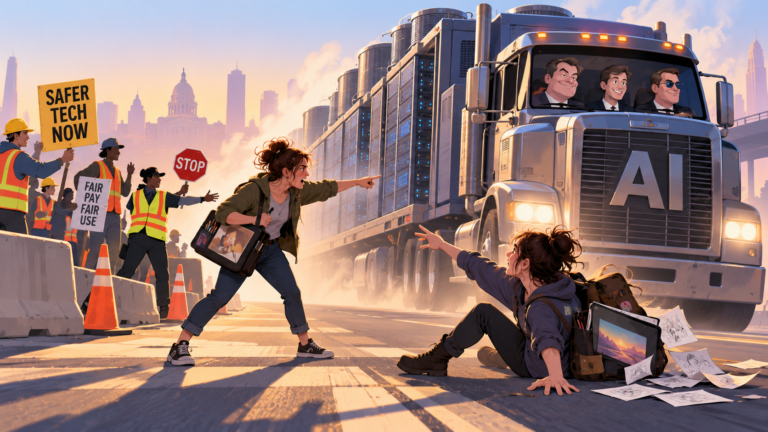
The client canceled the illustrator’s commission in thirty-one.
If you work in the arts, you probably don’t find that especially funny. Perhaps you spent ten years learning anatomy, light, perspective, and how to make a face express something more interesting than mild constipation. Perhaps you learned to photograph a product so its surfaces looked the way they actually look, or spent an entire afternoon persuading a violin to sound heartbroken without making it sound like somebody was torturing a cat.
Now an executive types a sentence into a box, gets something passable, and wonders aloud why you were charging so much.
I’d be angry too.
Meanwhile, the internet is filling with pictures nobody asked to see, songs nobody seems to have listened to before uploading, and entire galleries produced by people whose primary creative contribution was knowing where the Generate button lived. A painter posts something she’s been working on for three months. It gets buried between a thousand glossy fantasies of women with improbable armor and wolves standing in the snow. Somebody calls this progress.
There’s a temptation to declare the whole business fraudulent. The images aren’t art. The songs aren’t music. The people using the tools aren’t creators. If we all agree loudly enough, perhaps the machines will go away, the clients will return, and the internet will stop looking like the contents of a slot machine after it exploded.
I understand the temptation.
I also think it’s a terrible argument.
Not because the threat to working artists is imaginary. It’s real enough to pay the rent with, or rather to discover you can no longer pay the rent with. And not because the companies selling these tools have earned our unqualified admiration. They haven’t.
The argument is terrible because it mistakes a genuine fight over money, permission, power, and survival for a referendum on whether someone can make worthwhile art with a new tool.
Those are different questions. If we’re going to fight about them, we should at least have the decency to fight about the right ones.
What, exactly, are we defending?
I’ve known artists who could sketch a convincing face with a pencil while most people would still be trying to find the sharpener.
Actually, I’m one of them. Someone once said about me that I can draw Garfield better than Jim Davis.
I’ve known photographers who noticed light that everybody else walked past, and musicians who could turn a familiar melody into something entirely different by playing three notes a fraction of a second late.
I do those things too. Yeah, maybe not as well as some composers or camera operators, but I am competent with a DAW and a DSLR.
That skill matters. The long business of learning a medium changes what you can notice, what you can imagine, and what you can express – not unlike computer programming.
Sometimes the pleasure of making the work is inseparable from the act of making it. Somebody who loves the feeling of charcoal on paper doesn’t need me telling them that a machine can do the drawing faster. They already know. That’s not why they’re holding the charcoal.
But art has never had a single authorized manufacturing process.
A photographer does not paint every pixel. A collage artist may assemble images created by people born a century earlier. A film director can make a scene by guiding a cinematographer, performers, a lighting crew, and an editor. A composer may write music that someone else performs. A sculptor may have a foundry cast their work. The person with the idea, the person who executes it, and the person who determines whether it works aren’t always the same person.
Please don’t confuse that observation with an argument that all these methods are identical. They’re not. A camera records light from something in front of it. A generative model can invent a scene that never existed. The legal and ethical questions surrounding model training have no simple equivalent in buying a paintbrush. A musician who performs a song isn’t interchangeable with software that synthesizes something resembling a performance.
What the examples demonstrate is narrower, and I think harder to dismiss: the value of a creative act cannot be measured solely by how many individual marks, notes, or pixels the artist produced with their own hands.
The reverse is also true. Using an image generator does not automatically make you an artist any more than buying an expensive camera and a monopod automatically makes you a photographer.
I’ve seen photographs that made me stop and stare. I’ve also seen thousands of photographs of somebody’s lunch. The camera was doing roughly the same job in both cases. The difference was what the person behind it saw, intended, and managed to communicate.
The button is not the artist.
It is also not necessarily the enemy of the artist.
A painter, a photographer, a musician, and a god-damned graphic designer
Tinker, tailor, soldier, spy. Need I say more than I already have, Garak? O_o
Let’s get out of the courtroom for a moment and visit some actual studios.
An illustrator is developing a children’s book about a little girl who believes the moon is following her home. She draws the girl herself. She knows the shape of her face, the particular stubbornness of her posture, and why the moon ought to feel comforting in one scene and vaguely threatening in another. But she’s uncertain whether the nighttime street should be lit by shop windows or by a single streetlamp.
She can spend two days painting alternative backgrounds. She can photograph references. She can build the street in a 3D program. Or she can ask a generator for rough lighting ideas, decide that most of them are wrong, and find one that gives her a better understanding of the scene she was already trying to make.
If she returns to her drawing and makes a better picture, what exactly has been ruined?
Nothing.
Now suppose her publisher fires her and uses the generator to finish the book. That is a different event. The illustrator has lost a job. The publisher may also discover that maintaining the girl’s appearance, expressions, and emotional progression across thirty-two pages is harder than making one attractive cover. Or perhaps the software becomes excellent at that too, and the publisher never hires her again.
That possibility is painful. It doesn’t retroactively make the illustrator’s own use of the tool dishonest.
Next studio.
A photographer has been hired to photograph a family-owned restaurant. The owner wants pictures of the actual dining room and the actual food. The photographer knows where to put the lights so the soup doesn’t resemble something recovered from a storm drain. She knows how to keep the polished silverware from reflecting her own face. She knows that the plate arriving from the kitchen had better resemble what customers will be served.
Could an image generator make a beautiful picture of a restaurant? Certainly. It could probably make a more beautiful one, with happier customers and a dining room approximately twice its real size.
And that is why it would be the wrong tool if the picture is presented as an honest depiction of this particular place.
But the same photographer might be creating a surreal gallery piece in which an abandoned diner appears to float on the surface of the moon. She could photograph the diner, invent the landscape, and combine the two. Or she could direct a generated scene and modify it until it expresses something that would have been impractical to stage. The value of documentary accuracy in the first assignment does not make invention illegitimate in the second.
A photograph can be evidence. It can also be fantasy. The important thing is not to sell fantasy as evidence.
Down the hall, a composer is trying to score a short film. She hears a melody in her head, but can’t afford the string quartet that might show her whether it works. She can enter the notes into notation software and listen to a crude playback. She can use sample libraries. She can ask a music-generation system to explore different arrangements or textures, and then listen critically to what it gives her.
Maybe the result suggests a way to place the cello beneath the melody that she hadn’t considered. Maybe it’s dreadful. Maybe it gives her a perfectly competent but lifeless imitation of the emotional effect she was after, and she realizes she needs a single human voice singing almost under its breath instead.
That’s useful information. The machine has helped her make a decision about her music.
It has not proved that the musicians she might eventually hire are unnecessary, or that playing a violin is merely an inefficient way to manufacture violin noises. Performance contains choices about timing, attack, breath, and restraint that a composer may care about very deeply. Even if software reproduces those details convincingly, she may still want human performers because performing together is part of the work she intends to make.
And if a producer replaces paid musicians with synthetic performances to save money, those musicians have every reason to object to the economics of the decision. They don’t need to claim that a melody becomes metaphysically evil the moment a computer plays it.
Finally, because I can’t leave a graphic designer out of this discussion, there’s a neighborhood arts festival that needs a poster.
The organizer wants something joyful. An AI produces a gorgeous picture of musicians, fireworks, and a crowd dancing beneath the stars. The designer looks at it and notices that it says SATDURDAY, JULE 38, the sponsor’s logo resembles a wounded octopus, and the location is missing.
The designer fixes the information, checks that people can read it on a phone and on a wall, and chooses whether any of the generated image belongs in the final poster. She also makes sure the little QR code goes to the festival rather than the website of somebody selling cryptocurrency.
That’s design work. The picture is an ingredient. The poster is a communication problem.
Four people. Four different jobs. Four different reasons to use or decline a generator.
The mistake is to treat them as one profession with one acceptable workflow and one universal answer to whether AI belongs in it.
But I just want to make art
Good.
You should.
A great deal of the argument about AI and creativity seems to assume that everyone involved is producing advertising assets for a paying client. That gives us a wonderfully convenient measure of value: can the work accomplish a business objective, and will somebody sign the check?
But some artists don’t want to accomplish a business objective. They want to make a painting because they have a picture in their head that won’t leave them alone. They want to write a song for someone they love, photograph the last light on the porch of the house where they grew up, or draw an improbably elaborate dragon because dragons are fun.
Their work doesn’t have to improve a marketing campaign to count.
Neither does a generated image have to be sold, licensed, or incorporated into a corporate presentation to be worth making. A person who cannot draw the creature they imagine may be delighted to finally see it. A person with limited hand mobility may be able to compose scenes through language and repeated choices when the physical process of painting is inaccessible to them. Someone with little money can experiment with orchestration without paying an ensemble to rehearse every idea.
Those are real gains. They’re not excuses to exploit working artists, and they’re not proof that everyone now has the same skills as an illustrator or a composer. But they are reasons to be glad that more people can express ideas they previously couldn’t bring into the world.
If a grandmother generates an illustration of the dragon in a bedtime story she made up for her granddaughter, or somebody wants to actually see what their TTRPG character looks like in the outfit they just kitted out with their guildmaster, I refuse to regard that as a cultural emergency.
The internet may not need ten million more dragons. Her granddaughter might need exactly one.
There is a difference between widening access to creation and ensuring that creators can earn a living. We ought to care about both.
Historically speaking, most of society has never cared about the latter – after all, we don’t call them “well-fed artists” do we?
And we ought to be suspicious of anyone who says the first problem has been solved, therefore the second no longer matters.
The slush pile is real, and taste isn’t a pension plan
Here is the strongest practical objection I know.
When pictures, songs, and videos become nearly free to produce, the quantity of available work can rise far faster than anyone’s ability to pay attention to it. A gallery, publisher, music service, or potential customer can be buried beneath mountains of plausible material. Some of it will be excellent. Much of it will be competent in the way a hotel lobby is competent. It will offend nobody, surprise nobody, and be forgotten before the next thing arrives.
And some will be deliberately pumped into the market to occupy search results, collect tiny royalty payments, or imitate work people already wanted to see.
I already own more games on Steam than I’ll ever have the chance play in my lifetime. And those are just the ones I bought.
That is not a hypothetical concern about the dignity of craftsmanship. It’s a problem of discovery – and capacity.
An artist can make wonderful work and still be lost in the noise. The assumption that quality naturally rises to the surface was always optimistic; automated production makes it even less dependable.
This is where people promoting AI usually say something cheerful about taste becoming the new currency.
Please.
Taste matters, but the electric company doesn’t accept taste as payment. If an illustrator was earning money from a steady stream of modest commissions and those commissions disappear, telling her that she can now focus on her distinctive artistic vision is a particularly elaborate way of saying she’s unemployed.
A more honest argument is that abundant production makes finding, trusting, and sustaining worthwhile work harder. That creates an opportunity for human editors, curators, performers, teachers, critics, and communities with standards. It does not guarantee that any of those people will get paid enough to keep doing the job.
An artist’s reputation may become more valuable to certain audiences, especially people who want to know who made the work and why. Live music may remain important because a concert isn’t merely a file containing sound. A photographer’s signed print, a painter’s original canvas, or an illustrator’s handmade book can mean something different from a generated copy.
But different doesn’t always mean commercially protected. We should not confuse a reason to cherish something with a guaranteed market for it.
The industry has work to do. Platforms should distinguish human performances and documented photographs from synthetic substitutes when that distinction matters. Buyers should be able to find works by real people without wading through machine-produced spam. Publishers and music distributors need policies about impersonation and fraudulent uploads. Artists need practical ways to establish provenance and retain control of their work.
And, maybe, we should be using AI to make all the finding, judging, and curating just a little bit easier?
None of that requires declaring every AI-assisted piece worthless.
It requires admitting that an infinite supply of acceptable content does not create an infinite supply of attention, money, or honest dealing.
Yes, the training question matters
Some generative systems were trained on enormous collections of existing art and music, including material whose creators did not expressly consent to that use. Whether particular copying and training practices are lawful depends on the facts and the applicable law; disputes remain active. The ethical questions are broader than whatever a court eventually permits.
If a company profits from teaching its software to approximate the work of artists who never agreed to participate, those artists are entitled to ask where the material came from, how it was used, and why they aren’t sharing in the benefits.
The answer cannot simply be that human beings learn by looking at other human beings’ work.
Humans do learn that way. They also don’t ordinarily scrape millions of images onto industrial servers, offer a subscription service that can imitate particular creators on demand, and tell the creators that they should be grateful for the exposure.
Those are different acts. They deserve to be examined separately.
Music introduces another problem. A system can synthesize a plausible vocal performance. That doesn’t mean the singer whose recognizable voice it resembles has consented to perform the song. A fake recording can mislead listeners even if the melody is original. Similar problems arise with photographic likenesses, character designs, and promotional images that suggest an endorsement nobody gave.
Creators should be able to demand better information about training materials, pursue licensing arrangements where appropriate, challenge unlawful copying, and seek remedies for impersonation or deceptive uses. Companies ought to face the consequences of their own decisions about collecting data and selling the resulting tools.
I am not interested in pretending those issues go away because somebody made a beautiful image with the software.
But the reverse doesn’t follow either: that every person who uses a generator has committed the same wrong as the company that trained it, or that no art made with the tool can possess merit.
You can object to how a tool was built, demand better terms, choose a model whose provenance you trust more, and still recognize that the tool can be used creatively. You can decide the available choices are unacceptable and refuse to use it. That’s a legitimate position too.
What you can’t honestly do is substitute the sentence “AI art is theft” for the entire investigation. It doesn’t tell us who copied what, which use is in dispute, what permission existed, how a particular output was made, or what remedy would address the harm.
It’s a slogan. Sometimes slogans start an important argument. They don’t finish it.
The copyright office is not a talent judge
In the United States, the Copyright Office has explained that human-created expression in AI-assisted work may be protected. An artist may contribute protectable material by making original changes to generated elements or by creatively arranging them as part of a larger work. But merely giving a model a prompt does not, by itself, necessarily establish copyright ownership in the resulting expression. Purely AI-generated material is treated differently. The facts of the particular work matter.[1]
And what the artist is willing to reveal (or not) to the copyright office matters also. Call it a trade secret, if you wish.
This is both less exciting and more useful than the marketing promises.
It means an artist commissioning or selling AI-assisted work needs to understand what rights they actually have. A designer should not assure a client that the generated centerpiece of their logo is automatically exclusive. A composer should not promise rights that depend on samples, recordings, or a voice they were never authorized to use. A photographer should not present invented imagery as a picture of a real event.
And an artist who chooses to make something by hand should be able to say so without being accused of technological backwardness. If a gallery promises original paintings, it should exhibit original paintings. If a client pays for a human violinist, delivering a synthetic track without saying so isn’t innovation. It’s a lie.
Copyrightability and artistic worth are also separate questions. A work can move somebody deeply without satisfying the requirements for copyright protection. A document can be copyrightable and still be a miserable piece of art.
The law is not an oracle that whispers whether a painting has a soul.
It is a system for assigning particular rights under particular rules. Learn the rules. Don’t ask them to make your aesthetic judgments for you.
And, if it suits you, develop some political influence and make the politicians change the rules. Hey, it works for Mickey Mouse.
The artist is allowed to say no
An important point, because advocacy for new tools too often slides into a demand that everyone use them.
Nobody owes an AI company their art, their voice, their photographs, or their enthusiasm.
A watercolorist may love watercolor because pigment moves through wet paper in a way no prompt can replace. A photographer may prefer to capture whatever really happened in front of the lens, however imperfectly. A band may want to spend six weeks rehearsing an arrangement because the work of playing together is the point.
A client can choose to hire those people for exactly those reasons.
If you want a handmade quilt, a program that generates an excellent picture of a quilt hasn’t fulfilled the assignment, nor has a programmable sewing machine. If you want an honest photograph of your grandfather, a convincing picture of somebody who resembles him may be the last thing you need. If you want to hear your sister sing, an immaculate synthetic performance in her style is not a substitute for her being there.
The medium can be – and often is – part of the meaning. AI itself can also be the medium, but that should never be mandatory.
The strongest defense of AI-assisted art must leave room for art that refuses AI entirely. Otherwise we’re not defending artistic freedom. We’re replacing one compulsory practice with another, only this time the person setting the rules also sells monthly subscriptions.
And artists who choose to use generators deserve the same basic courtesy. Judge what they actually made, how they made it, what they claim about it, and whether they respected the rights of others. Don’t declare them counterfeit humans because one of their tools has a power cord.
Who gets the future?
I want to see artists helping decide how these technologies are developed and used, rather than discovering the rules in a revised terms-of-service agreement at three in the morning.
That means straightforward choices, not magic words.
When a photographer licenses a picture, the contract should be clear about whether the client can use it for model training. When a studio hires a performer, the deal should say what can and cannot be done with the performer’s voice and likeness. When a publisher buys an illustration, everyone involved should understand whether generated components are permitted and what claims may be made about the final work.
Artists should be able to insist on human-made work where that was promised. People who use AI should be able to describe their process without automatically forfeiting their standing as creators. Customers should be told when a picture is an illustration rather than evidence. A composer shouldn’t discover that a recording of her voice has become somebody else’s virtual singer.
And if a company saves a fortune by replacing paid creative work, it should not expect applause for explaining how efficient its software is. The people whose labor made the industry valuable have interests that must be represented in bargaining, contracts, and law. Productivity alone does not guarantee fairness.
There are better and worse ways to build these systems. There are better and worse ways to use them. The distinction is worth fighting for.
I would rather have working artists at that table than leave the decisions to software vendors, financiers, and marketing departments who regard the word content as an adequate description of everything people make.
One image worth keeping
Imagine a child who asks her grandfather to tell her a story. He makes one up about a stubborn little dragon who keeps trying to light the candles on a birthday cake and accidentally sets the tablecloth on fire.
He cannot draw. Perhaps his hands shake. Perhaps he never had time to learn. So he describes the dragon to a generator, works through a few attempts, rejects the ones that miss the joke, and prints a picture to go with the story.
The child loves it.
Now imagine a professional illustrator who spends a month creating a picture book about the same kind of dragon. The gestures are better observed, the jokes are richer, the story builds from page to page, and the whole thing bears the imprint of a mind that has spent years learning how to communicate through pictures.
I want that book to exist too. I want the illustrator to be paid. I want readers to find it without having to dig through nine thousand generated dragon books uploaded overnight by somebody hoping to collect a few pennies per click.
I don’t see why the grandfather’s picture must be declared illegitimate for the illustrator’s work to deserve protection.
Nor why the illustrator should be told to stop worrying about her mortgage because the grandfather has discovered the joy of image generation.
Both people are telling stories. Their circumstances are different. Their abilities are different. Their obligations to others are different.
A machine helped one of them make a picture. It may someday help the other make an even more ambitious book. Or she may never touch one, and make something wonderful without it.
Those possibilities can coexist.
What cannot coexist indefinitely is an economy that asks artists to supply the imagination, examples, and cultural value on which new tools depend, then treats their livelihoods as an unfortunate accounting adjustment.
So yes, fight over training. Fight over licenses. Fight over impersonation, payment, disclosure, and the tidal wave of disposable material obscuring the people who have something worth saying. Those are fights worth having.
But don’t tell the grandfather that he didn’t make something meaningful for the child. Don’t tell the artist that the only legitimate way to create is the one with the greatest amount of manual labor. And don’t hand the entire future of these tools to the people who own the servers because everybody else was too busy arguing about whether pressing a button counted as cheating.
The button isn’t the artist.
It’s not the painter, the photographer, the illustrator, the composer, or the person who knows when the music should go quiet.
Those are people.
I’d like to keep them in charge.
Source note:
[1] U.S. Copyright Office, Copyright and Artificial Intelligence, Part 2: Copyrightability (January 29, 2025), https://www.copyright.gov/newsnet/2025/1060.html ; and Copyright and Artificial Intelligence, including Part 3 on generative-AI training, https://www.copyright.gov/ai/ . The Office’s reports describe U.S. copyright policy; they do not resolve every training dispute or determine the artistic value of a work.