Category Contemporary AI Issues

Stop Dancing in Traffic
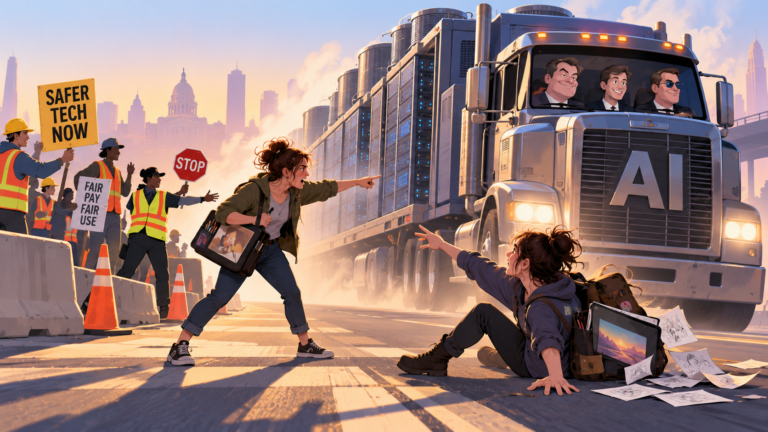
Three corporate executives drive an enormous AI-powered data-center truck toward two artists in the roadway, while road workers and demonstrators attempt to stop it and demand safeguards.

Artificial intelligence is disrupting livelihoods, threatening creative professions, consuming enormous resources, and raising serious questions about corporate accountability and safety. The people who are angry about these things have good reasons to be.

But if you're an artist watching your commissions disappear, you're not the enemy. And if you're a writer, programmer, musician, or small-business owner using AI to keep your career afloat, you're not the enemy either.

So why are we fighting each other?

In Stop Dancing in Traffic, Doctor Wyrm challenges the growing tendency to treat ordinary users of artificial intelligence as accomplices in every questionable decision made by the companies developing it.

From copyright and job displacement to data centers, environmental costs, cognitive dependence, and the rush toward AGI, the problems deserve serious scrutiny. So do the people and institutions responsible for them.

But opposing exploitation doesn't require refusing every useful tool, and learning to use new technology doesn't mean endorsing everything about it.

We can defend working artists, demand safer technology, fight for fair compensation, and still recognize that people need to survive the world as it exists today.

The people trying to make a living aren't necessarily your enemies. They may be standing in the same dangerous roadway you are.

Maybe it's time we stopped fighting each other and started holding the drivers accountable.
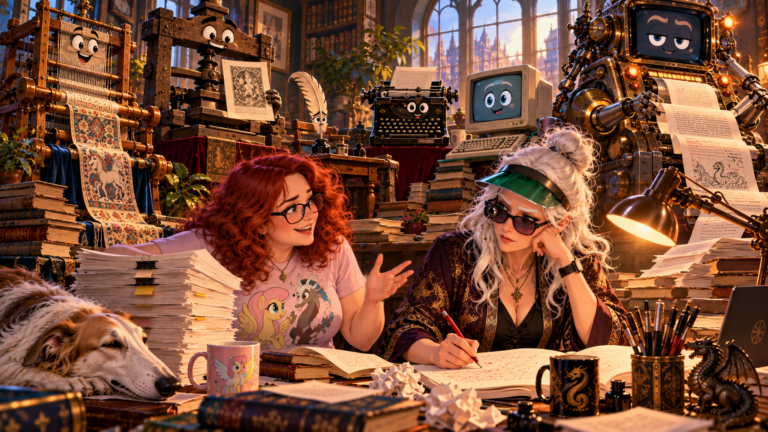
The Keyboard Has Never Been the Author

Auburn-haired author Alara debates her enormous manuscript with white-haired editor Tomiko, wearing sunglasses, a green editor's visor, and holding a red pencil. Behind them, a personified printing press, silk loom, typewriter, computer, and retro-futuristic AI robot compete for attention.

A machine can write a paragraph in seconds. Sometimes it's even a good paragraph. But does that make the machine an author — or the person using it a fraud?

Writers have always relied on tools, collaborators, editors, researchers, and ghostwriters. Generative AI introduces extraordinary new capabilities, but it also raises serious questions about copyright, creative ownership, professional livelihoods, and the integrity of published work.

In The Keyboard Has Never Been the Author, Doc Tomiko challenges the assumption that legitimate authorship requires personally producing every word. Through examples from fiction, journalism, publishing, and developmental editing, she argues that the true work of writing lies in imagination, intention, critical judgment, and responsibility for the finished product.

AI can generate prose, suggest revisions, and help people tell stories they might otherwise never write. It can also produce mountains of mediocre garbage and give publishers new excuses to stop paying professionals.

The question isn't whether a machine helped write the words. It's who decided what those words should mean, whether they belong, and whether they're any damned good.

The keyboard was never the author. Neither is the AI.

The Button Isn’t the Artist

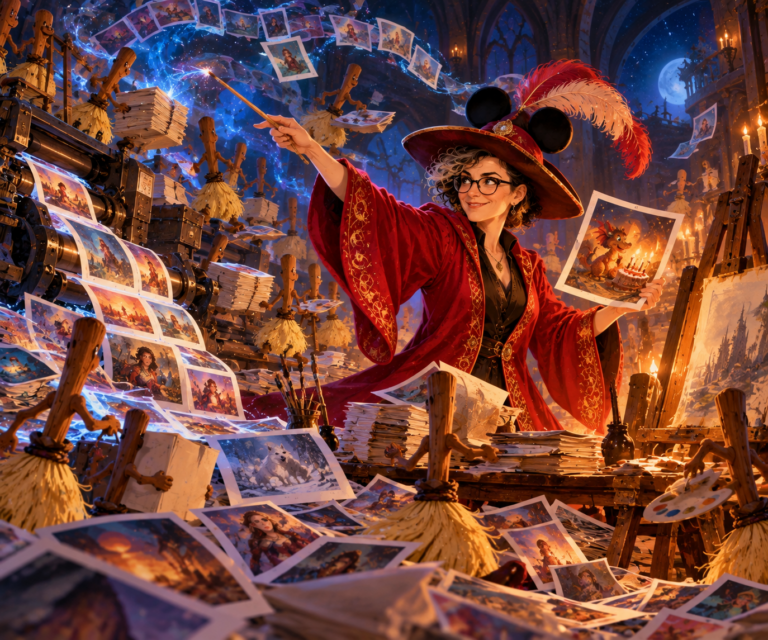
A bespectacled sorceress in red robes and a feathered, mouse-eared tricorne hat directs magical broomsticks producing mountains of AI-generated artwork in a fantastical studio.

An AI can produce a beautiful picture in thirty seconds. It can also cost a working illustrator their next commission. Both things can be true.

Generative AI has sparked a bitter argument about creativity, copyright, consent, and the survival of professional artists. But somewhere along the way, we've confused the ethics of building and selling these tools with the artistic legitimacy of using them.

Through examples from illustration, photography, music, and graphic design, The Button Isn't the Artist examines what AI changes about creative work—and what it doesn't. It confronts the realities of displaced labor, questionable training practices, copyright, and an internet drowning in disposable content without dismissing the genuine creative opportunities these tools provide.

The machine can make the picture. But making something meaningful still requires a person with an idea, judgment, and something worth saying.

The button isn't the artist. And it isn't necessarily the artist's enemy.

The Machine Can Write the Code. You Still Have to Know What the Hell You’re Doing.

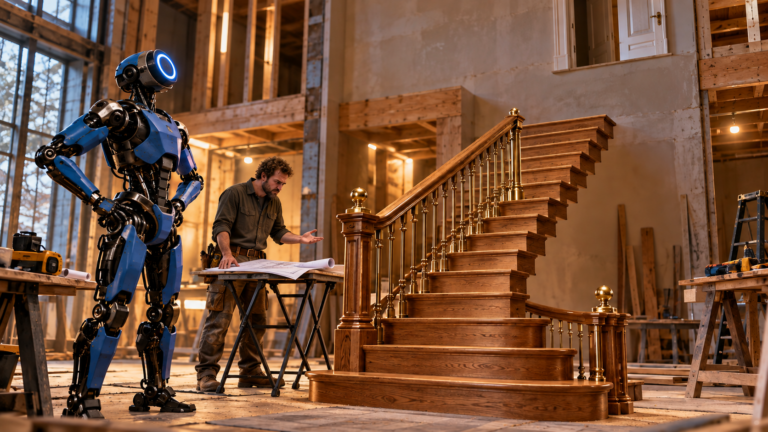
A blue-and-black humanoid robot stands proudly beside an ornate wooden staircase that stops short of the second floor, while a frustrated architect examines blueprints on a folding table.

If artificial intelligence can write better code than most humans, why bother learning how to program? Because programming was never just about writing code. It was about understanding problems, challenging assumptions, testing solutions, and recognizing when a machine has done exactly what it was told—and gotten everything wrong. As AI makes software development faster and more accessible, computational literacy becomes more important, not less. Learning to program isn't about competing with the machines. It's about knowing what to ask them to build, whether the result works, and when to tell them to stop.