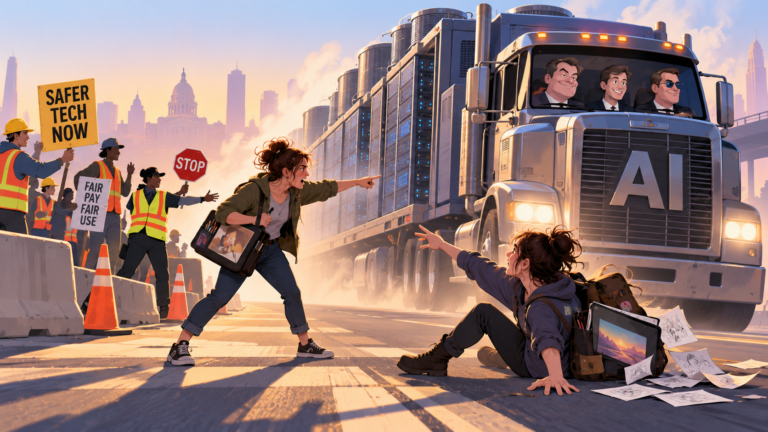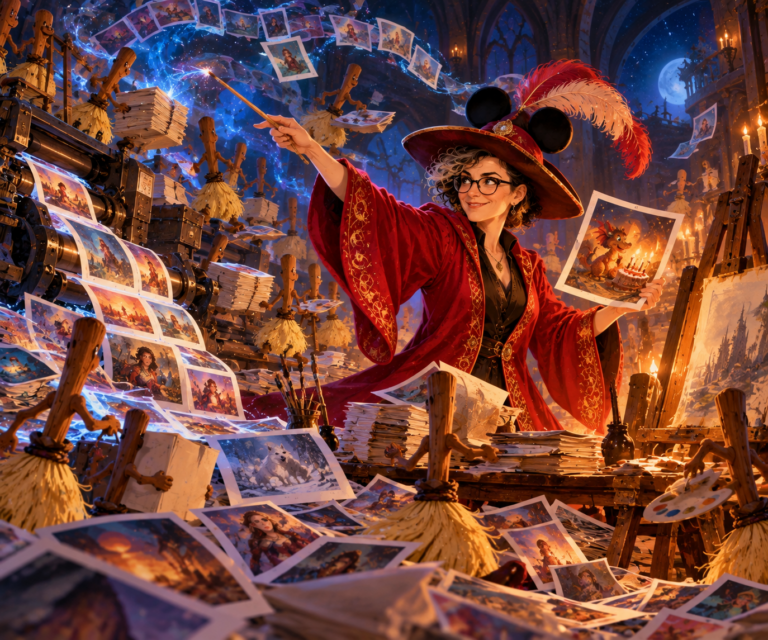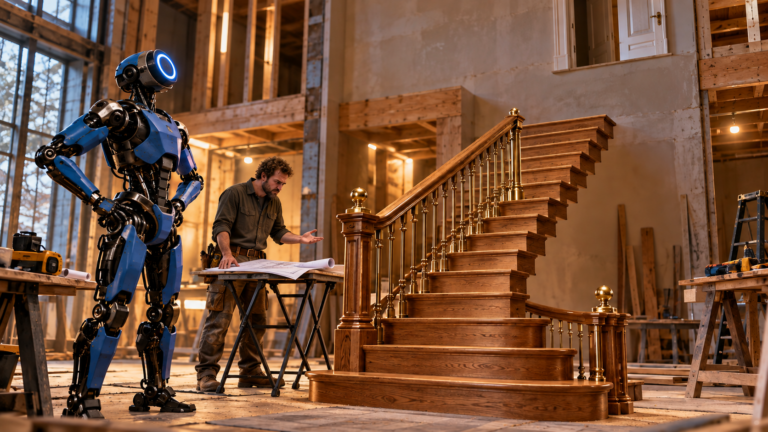
Why writers and editors should stop treating artificial intelligence as a threat to the very idea of writing — and start demanding that it serve the people who actually have something to say.
There is a particular kind of outrage that attends every new technology used to make art. You can recognize it by the conviction that the previous generation of tools represented the last morally acceptable way of accomplishing anything.
The pencil was honest. The typewriter was mechanical. The word processor removed the smell of correction fluid, and therefore presumably the soul of literature. Spellcheck was cheating. Grammar check was worse. Google made research too easy. Wikipedia was going to destroy civilization, a project it has pursued with considerably less enthusiasm than some of its critics — at least for the English version.
Now a machine can write an entire paragraph.
Sometimes a good one.
And an awful lot of people who make their living from words have responded as though the machine has broken into the library, murdered the English language, and made off with the good silver.
I understand the reaction. I write. I edit. I know what it costs to get a sentence exactly right, particularly when the sentence has spent the last forty-five minutes expressing its determination not to cooperate. I know that a book is not a pile of words any more than a house is a pile of lumber. And I know there are people who look at generative AI and see a way to stop paying writers while continuing to sell writing.
Those people exist. Some of them have budgets.
But I also think that refusing to recognize AI-assisted writing as legitimate creative work is a serious mistake. Not because every machine-generated paragraph is good, or because every company building these systems deserves a medal, but because the argument confuses the production of prose with the practice of authorship.
Those have never been the same thing.
Who wrote the book?
Let’s start with an uncomfortable fact about literature: not everyone whose name appears on a book’s cover personally typed — or dictated — every sentence inside it.
Authors work with editors. Some work with research assistants, translators, book doctors, and ghostwriters. Journalists work with fact-checkers and copy desks. A celebrity’s memoir may contain hundreds of pages of beautifully shaped prose supplied by someone whose name appears in considerably smaller type, if at all. A novelist may accept an editor’s rewritten paragraph because it solves a problem the novelist has been staring at for three weeks.
We can and should debate fair credit and compensation in all these arrangements. A human ghostwriter deserves a contract and a paycheck; a literary editor isn’t an interchangeable kitchen appliance. The analogy to AI is not exact, and pretending otherwise would be a cheap trick.
But the existence of collaborative writing establishes something rather important: authorship has never required solitary control over every keystroke.
An author may conceive the work, establish its purpose, direct its development, evaluate alternatives, make final decisions, and assume responsibility for what appears under their name. Some authors also write every word. Good for them. Others don’t. That is not, by itself, the measure of whether the resulting work has an author.
The real questions are what the person contributed, what they controlled, what rights they possess, and what they are honestly representing to readers and collaborators.
Imagine two novels.
In the first, a writer spends four years typing every word personally, never accepting feedback, revision, or assistance. The story has seven chapters in which nothing much happens, a protagonist whose motives change without explanation, and an ending apparently constructed from whatever was left in the author’s refrigerator.
In the second, the author devises the characters, plot, setting, emotional logic, and voice; uses an AI to try different scene constructions; discards most of them; rewrites what survives; and spends another six months interrogating the manuscript until every sentence earns its place.
Which novel is better?
You cannot answer that question from the production methods. You have to read the books.
There is no secret literary enzyme released when skin touches keyboard. The reader cannot recover the moral value of a paragraph by calculating how many human fingertips were involved in producing it.
The prose must do the work.
And the person presenting the work must answer for it.
The awful first draft is not a sacred animal
Writers romanticize struggle. I suspect this is partly because we have endured so much of it that admitting some was unnecessary would be intolerable.
A difficult paragraph may represent an important artistic discovery. Wrestling with language can change what you think. The act of writing sometimes reveals the idea. I would never tell a writer who works that way to abandon the process. For that person, the labor is not incidental to the art.
But not all suffering is revelation.
Sometimes the suffering is discovering that the third paragraph repeats the first. Sometimes it is turning twenty pages of meeting notes into six paragraphs of readable exposition. Sometimes it is making the fifth attempt to explain a mechanical process without accidentally implying that electricity flows uphill because it was raised badly.
Sometimes the work is difficult because the work is difficult.
Sometimes it is difficult because your tools are shit.
An AI can offer a novelist three ways to structure a scene, an editor a second opinion about where a chapter loses momentum, or a nonfiction writer an outline that exposes a missing argument. It can produce a rough version of the passage you were trying to approach sideways, giving you something concrete to reject.
Rejection is underrated as a creative act. Knowing exactly why a proposed sentence is wrong often tells you more about your intended sentence than an hour spent staring at the cursor.
Sir France’s Bacon said, “An hour on Discord is worth a day’s meditation.” … or something like that — though I do like the idea of uploading bacon into a chat app.
I would not recommend publishing the first version merely because the machine produced it quickly. I wouldn’t recommend publishing the first version produced by a human, either. Most manuscripts benefit from passing through the remarkable transformation known as somebody actually reading the damned thing – just like I read this, more than once.
The advantage is not that AI eliminates the need for discernment. It gives discernment more material to work on, at lower cost.
For writers who freeze before a blank page, that can be liberating. For writers who already have too many pages, it can be a menace. Different problems call for different tools. We do not demand that every novelist employ dictation software or a fountain pen, and we needn’t demand universal enthusiasm for AI.
Though, to be perfectly honest, my wife could benefit from AI to tell her how to cut about 100,000 words from the novel she’s been nursing like a baby that wouldn’t grow up since 2006 – about half the story, actually. Is that 2 novels with a 3rd in the trilogy or just a bunch of crap that should go into deep-lore? I’m the sad sack of shit who agreed to read it all and tell her.
What we should reject is the idea that choosing to use it somehow invalidates every legitimate judgment made afterward.
And these days, our judgment is fan-fucking-tastic. ^_^
The editor is not being replaced by a machine. The editor is being presented with a larger pile of trouble.
Here’s where editors ought to become interested.
Generative AI can produce grammatical sentences in astonishing quantities. This is, in some respects, the least interesting thing about it.
The publishing world was already capable of producing grammatical sentences in astonishing quantities. Its more pressing problem was deciding which of those sentences belonged in books.
Editors know that a paragraph can be technically correct and artistically disastrous. They know when a writer has explained what the scene already demonstrated, when a metaphor draws attention to itself, when a character’s dialogue sounds suspiciously like the author’s opinions wearing a hat, and when a footnote is trying to conceal the fact that the main argument doesn’t work.
An AI may recognize many of these faults. It may identify them brilliantly. It may also recommend removing the most interesting passage in a manuscript because that passage violates a pattern the model has come to expect.
This is why the editor’s job is not merely to detect errors. It is to exercise taste in the service of a particular work.
Consider a novel whose narrator talks incessantly about trains, plumbing, restaurant menus, and the proper method of repairing an electrical switch. Then, at the moment of greatest emotional exposure, the narrator says almost nothing.
A generic cleanup pass could treat the digressions as irrelevant and the silence as insufficiently developed. It might produce a smoother book, the way a belt sander can produce a smoother antique table by removing everything that made it interesting.
The competent editor asks why those passages are there.
Perhaps the trivia establishes expertise. Perhaps it masks grief. Perhaps the apparent digression is the mechanism of the revelation. Perhaps the writer really does need someone to say, “I love you dearly, but nobody needs nineteen pages about train brakes before breakfast.”
That decision belongs to an editor who understands the work, not to a rule about ideal paragraph length.
Now imagine editors with tools that can compare versions, locate continuity errors, generate editorial queries, test alternate chapter orders, and help an author understand why a transition fails. More manuscripts become accessible to serious attention. A small publication can afford better production support. An overworked editor can spend less time fixing typographical debris and more time dealing with structure, credibility, and style.
Could a publisher instead decide to fire half the staff and make the remaining editors supervise an automated sludge pump? Of course. Publishers have found ways to impoverish their own product without the assistance of machine intelligence for centuries.
The possibility of bad management is an argument for better management and stronger labor protections, not for declaring the underlying tool artistically illegitimate.
Fiction isn’t journalism, and journalism isn’t a novel
I would be a fool to insist on one ethical rule for every form of writing.
In fiction, the author is permitted to invent people, events, weather, civilizations, and entire systems of government whose documents continue to insist that the vanished citizens were never there. A fictional scene’s immediate duty is to the work’s internal truth, not to a historical record.
An AI can help a novelist explore consequences: If the door is locked, how did the witness enter? If a character knows the secret by Chapter Three, why is she surprised in Chapter Nine? If the ship takes two hundred years to reach its destination, what happens to the people who were born aboard it?
That isn’t cheating. It’s the sort of inquiry that makes fiction more coherent.
The author can keep, discard, or transform the proposed answers. The difficult part remains deciding which possibilities belong to the story and which ones would make it a different story. An interesting novel is not a vote among the ten most statistically plausible continuations of its last paragraph.
Nonfiction carries another burden.
If you’re writing about a real bridge collapse, a medical study, a court decision, or the behavior of a real government official, the facts don’t become optional because the prose sounds confident. AI systems can generate nonexistent citations, combine incidents that occurred years apart, mistake commentary for primary evidence, or supply quotations nobody actually said.
An editor who lets fabricated evidence into a published investigation cannot excuse the result by explaining that the text came from a model. Neither could that editor excuse it by saying an inexperienced intern had written the passage.
Use AI to organize notes, find questions, propose interview angles, summarize material for checking, and examine whether an argument actually follows from the evidence. But verify consequential claims against real sources. Preserve original interviews and records. Do not present generated quotations as testimony. Do not pretend a machine attended a meeting, visited a disaster site, or spoke to a witness.
I have no objection to machine-assisted nonfiction. I have a considerable objection to fiction masquerading as nonfiction because someone didn’t check the facts.
These principles are compatible. We can use the tool and keep the obligation.
In fact, better tools may make competent verification more accessible, if we insist on verification rather than accepting eloquence as evidence.
The two copyright questions people keep trying to make into one
Now we arrive at the fight that deserves to be taken seriously.
Many writers object not merely to how AI-generated prose is used, but to how the underlying systems were trained. They ask whether their copyrighted work was copied without permission, whether model makers should compensate them, and whether a technology built partly upon their labor will then compete against them.
Those are not ridiculous questions. They are among the most important questions in the industry. And they are not resolved by pointing out that human writers learn from reading books.
Humans read books; machines are trained using data at industrial scale. There are similarities worth examining, but there are also differences in copying, storage, licensing, economic impact, and the technologies involved. An analogy is not a legal ruling, and a legal ruling is not necessarily a fair bargain.
As of this writing, important questions about the use of copyrighted material for AI training remain contested in U.S. courts. Particular cases turn on how works were obtained, how they were used, and potential market effects. Anyone promising that all training is plainly lawful — or plainly unlawful — is selling certainty that the law has not delivered.[1]
A separate question concerns ownership of the output. In the United States, the Copyright Office has said that human-authored expression in AI-assisted work can receive protection, including qualifying creative selections, arrangements, and modifications, while purely machine-generated material without sufficient human authorship does not become copyrightable merely because somebody entered a prompt.[2]
That’s a meaningful distinction. It discourages treating the generator as a magic copyright vending machine, while leaving room for actual human creative authorship.
But the moral argument matters even where the legal arguments are unsettled.
Creators should be able to negotiate over the use of their work. Model providers should be pressed on provenance, licensing, compensation, and mechanisms to prevent regurgitation or impersonation. Publishers should not pass off machine-written material as personally reported journalism. Contracts should say what kinds of assistance are permitted, what needs disclosure, and who is responsible for accuracy and originality.
None of this requires pretending that every legitimate AI-assisted manuscript is stolen goods.
We are capable of distinguishing the operation of a tool from the commercial practices of companies selling it. We already do that in publishing, where the moral status of editing software doesn’t hinge on whether every software vendor pays fair wages, respects privacy, or treats freelance workers decently.
The proper response to abuse is accountability — not a religious prohibition on touching the technology.
Nobody wants to read your machine’s homework
Let’s get another uncomfortable truth onto the table: most raw AI writing is not particularly memorable.
It may be perfectly serviceable. It may organize information cleanly. It may sound like a corporate newsletter edited by a committee determined not to offend anyone who has ever purchased office supplies.
And if you ask it to write “in a compelling, witty voice,” you may receive prose so delighted by its own cleverness that you begin searching for the nearest fire exit.
This is a genuine problem. But it is a problem with a workable remedy: don’t publish generic sludge. Insist on quality.
The remarkable thing about an enormous supply of adequate sentences is that adequacy becomes less valuable. What’s scarce is not the sentence that reports what happened. It’s the judgment to decide what matters, which detail changes the reader’s understanding, what remains ambiguous, where the argument is dishonest, and when to shut up – in other words meaning.
A writer who can tell a story that makes syntactical and semantic sense will not be sufficient when literally anyone can do it. Writers who have something particular to say become more important in an environment where fluent prose costs almost nothing.
Editors who know how to recognize a particular mind become more important, too.
This does not mean the market will automatically reward them. Cheap content can bury fine work, and platforms have a regrettable history of confusing engagement with merit. We may need labeling practices, editorial standards, provenance systems, better discovery mechanisms, collective bargaining, and protections against automated spam masquerading as literature.
We should fight for those things.
But the solution to a flood of mediocre writing isn’t to insist that all the mediocre writing be produced slowly by hand.
It’s to make room for work worth reading, and to refuse to publish the rest.
There are stories that weren’t getting written
The most compelling argument for AI-assisted writing may not come from a professional novelist at all. It may come from someone who has a story but cannot easily turn it into conventional prose.
Perhaps English isn’t their first language. Perhaps they have a disability affecting typing or speech. Perhaps they understand the history of their community in astonishing detail but were never taught how to organize an essay. Perhaps they can imagine characters and conflicts but find that the mechanics of composition consume all the energy they wanted to spend on storytelling.
We have traditionally told such people that writing requires mastering the medium before anyone is obliged to listen.
Now we can offer assistance that doesn’t require a large advance, a professional ghostwriter, or the generous attention of a stranger with six months to spare.
Will all those people become good writers? Certainly not. Neither do all the people who learn to type.
But more people will be able to attempt work that previously lay beyond their reach. More historians can preserve local memories. More small organizations can publish useful guides. More independent creators can develop manuscripts before risking money on professional services they cannot afford.
Some of those works will be genuinely excellent.
The publishing industry should regard that as an opportunity, not a contamination event.
There will be new authors to discover, new audiences to serve, and new forms of collaboration to build. Professional editors may become the people who help these creators turn promising material into lasting work, rather than the guardians of a gate the creators could never afford to approach.
I’d consider that a rather good use of editorial expertise.
What does honest authorship look like?
I don’t think the ethical standard should be, “Did a machine touch this manuscript?” That standard will become increasingly useless as ordinary writing software incorporates generative assistance into search, revision, dictation, translation, and layout.
A better set of questions is practical.
Who decided what the work would say? Who selected and revised the expression? Who checked what needed checking? Who has the right to use the source material? Who bears responsibility for the result? Were collaborators treated according to their agreements? Were readers or clients led to believe something material that isn’t true?
An author who uses an AI to generate alternatives and then makes the work their own through substantial creative judgment is doing something different from a publisher who commissions a machine-written book, barely looks at it, and sticks a famous person’s name on the cover.
A journalist who uses AI to clean up interview transcripts while checking against the recording is doing something different from a journalist who invents an interview through a chatbot.
Although… I’ve certainly interviewed enough LLMs to realize that the latter isn’t necessarily evil.
A publisher that discloses AI assistance according to a clear contract is doing something different from one that secretly replaces a contracted human writer with a machine while continuing to bill the client for that writer’s services.
These distinctions are not difficult to comprehend. We simply have to stop pretending the entire field consists of one undifferentiated moral event.
Some uses deserve criticism. Some deserve prohibition. Some deserve compensation agreements or explicit consent. And some are ordinary, defensible creative practices that happen to involve a new kind of machine.
There is no contradiction in holding all those positions simultaneously.
The people who decide what matters
I have a suspicion about the future of writing, and it is not that authors will all become prompt engineers, a term whose shelf-life may yet prove considerably shorter than the books we hope to write.
I think the division between producing words and deciding what those words ought to do will become more visible.
For some writers, making each sentence by hand is essential to their practice. They should continue. I wouldn’t dream of taking that pleasure away from them. For others, writing is a process of directing, assembling, questioning, discarding, and revising. They should be free to use the tools that serve that process, provided they behave honestly toward everyone involved.
The author who wants to be judged by the work has to accept responsibility for its defects as well as its achievements. You don’t get to take credit for the brilliant ending and blame the model when Chapter Four contradicts Chapter Two. You published it. You own that decision, whatever the applicable copyright law says about particular passages.
And the editor who wants to defend the craft should defend the actual craft: clarity without flattening character, originality without pretending that influence doesn’t exist, sound evidence, earned emotion, formal judgment, and a useful relationship with the reader.
The keyboard never supplied those things.
Neither did the typewriter, the printing press, nor the ink. They were instruments, sometimes delightful and sometimes infuriating, through which a person made decisions.
Artificial intelligence is a much more capable instrument, and a more complicated one. It can suggest, imitate, combine, and occasionally surprise us. Its development raises hard questions that deserve real answers. It will disrupt labor markets, and anyone who dismisses that disruption as an inconvenience to be endured by somebody else can go directly to hell.
But none of that makes responsible AI-assisted writing counterfeit art.
If anything, it gives us an opportunity to insist upon the part of writing that matters most: the intent, the investigation, the imagination, the craft of choosing and refusing, and the willingness to be answerable for what we’ve put into the world.
Someone still has to decide whether the sentence belongs there.
Someone still has to decide whether it’s true.
Someone still has to decide whether it’s any good.
And somebody, sooner or later, will have to tell the author that they wrote a hundred thousand words too many, that they are telling more than one story, or that the third chapter is a total disaster.
That somebody may be aided by a machine. I hope they are. The chapter probably needs all the help it can get.
But the machine won’t make the judgment matter.
The writer and the editor will.
Source notes (for legal context, not a claim that any court has settled the ethics of art):
[1] U.S. Copyright Office, Copyright and Artificial Intelligence, including Part 3 on generative-AI training, https://www.copyright.gov/ai/ ; American Bar Association, Generative AI in Entertainment and Unsettled IP Questions (2026), https://www.americanbar.org/groups/entertainment_sports/resources/entertainment-sports-lawyer/2026-fall/generative-ai-entertainment-unsettled-ip-questions/
[2] U.S. Copyright Office, Copyright and Artificial Intelligence, Part 2: Copyrightability (January 29, 2025), https://www.copyright.gov/newsnet/2025/1060.html