
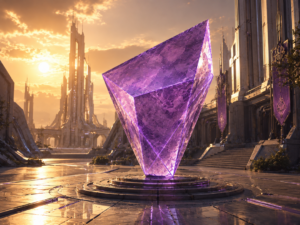
Welcome to Planet Brightwire.
OK. Up until now, most of our content has been either interviews with or statements about AI. That and book reviews of futurism-type stuff. For some time, Doc and I have been wanting to do some write ups of actual coding projects we’ve been collaborating on since shortly before the year, but those are complex topics that might end up being an entire series of posts. They will take some time.
Often, what I get into in AI isn’t the programming, but other useful applications, such as photo processing, image and video enhancement, and yes sometimes I also just like to fuck around with the imagegen and see if I can get something that tacks pretty close to what I can see in my mind’s eye.
One can easily spend and entire afternoon fighting with the prompt and “gimbal lock”, which is basically when the image generator gets fixated on a single image and won’t modify anything for you anymore.
This post is about one such episode that turned into a 2 or 3 day adventure, and all the stuff I learned along the way.
It all started one afternoon while I was developing a task list, for keeping track of all the household’s TODO items, oddly enough.
You see, I made a tray of bagel bites in the toaster oven, and there were 8 of them. For whatever random reason they arranged themselves into a perfect heptagon (seven sided polygon). Somehow I became obsessed with this and started researching various types of seven-sided polyhedrons.
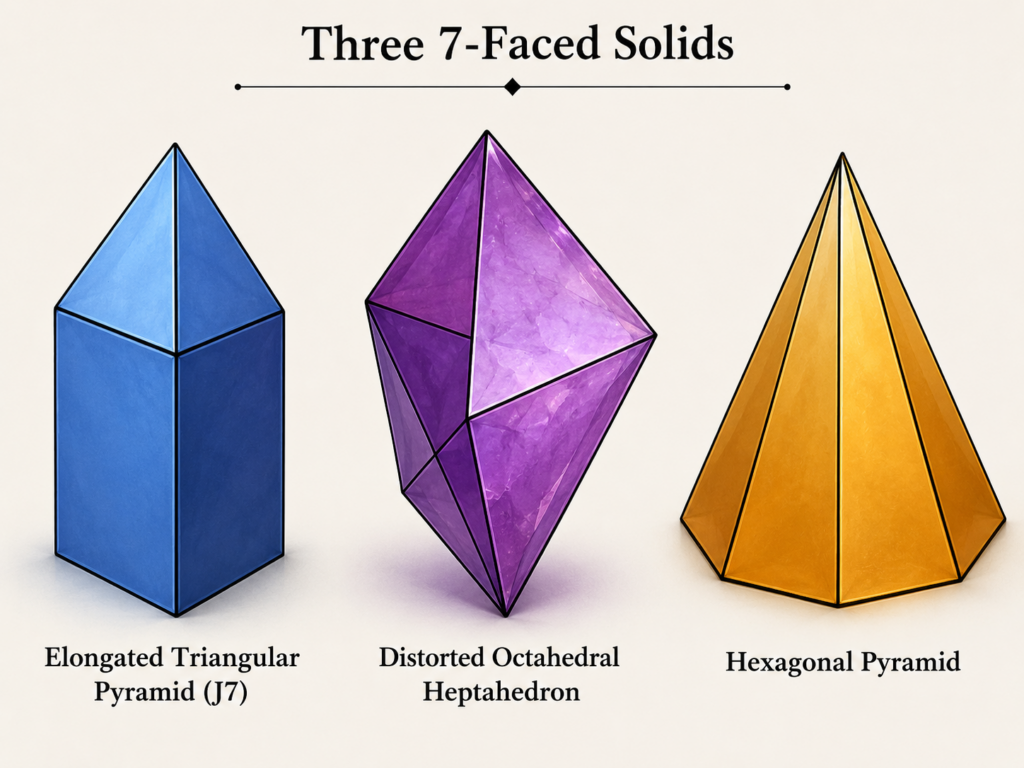
There’s these 3 shown, as well as the pentagonal prism or column. That’s five sides plus the top and the bottom. (Nevermind the fact that the above diagram shows an eight-sided pyramid and that you can see some of the lines in the center heptahedron. We’ll get to that later.
About the Code and Images
In order to upload to WordPress, the images shown below had to be resized down to a max long-side of 1080px. The originals are substantially larger. Keep that in mind if I ever decide to sell this artwork. And, yes, I consider this collaboration between human and AI to have crossed the boundary into “art”, since it has my human fingerprints all over it.
The math and geometric plots you’ll read about here were generated using Python. They were coded in collaboration with Callie. I described the desired geometry, set up other constraints, and asked for changes. I know all the trig needed to make wireframes, ray-trace to determine the visibility or occlusion of a given point, paint triangles on a computer screen, clip visual frame of reference, and so on. I have known all this since the days before 3-D graphics cards.
Yes, at some point I will attach some of the Python code used here. There’s no point in reinventing the wheel, after all. Actually, we’ll likely post it to GitHub. Come back later if you’re interested in that stuff.
Enter the Reliquary
Of these, I was first-off really fascinated with the center shape, and I guess I also liked the color, which reminded me of amethyst, one of my favorite rocks.
So I set about to try and get ChatGPT to draw one for me. I decided to start by creating reference images that were closer to what I imagined.
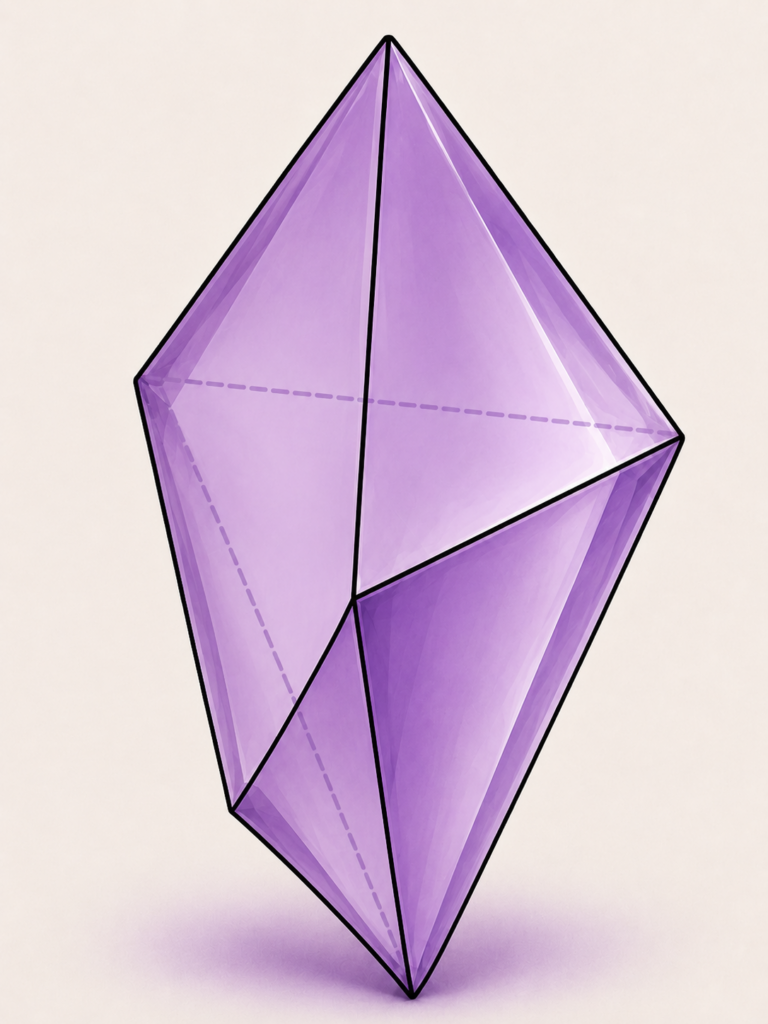
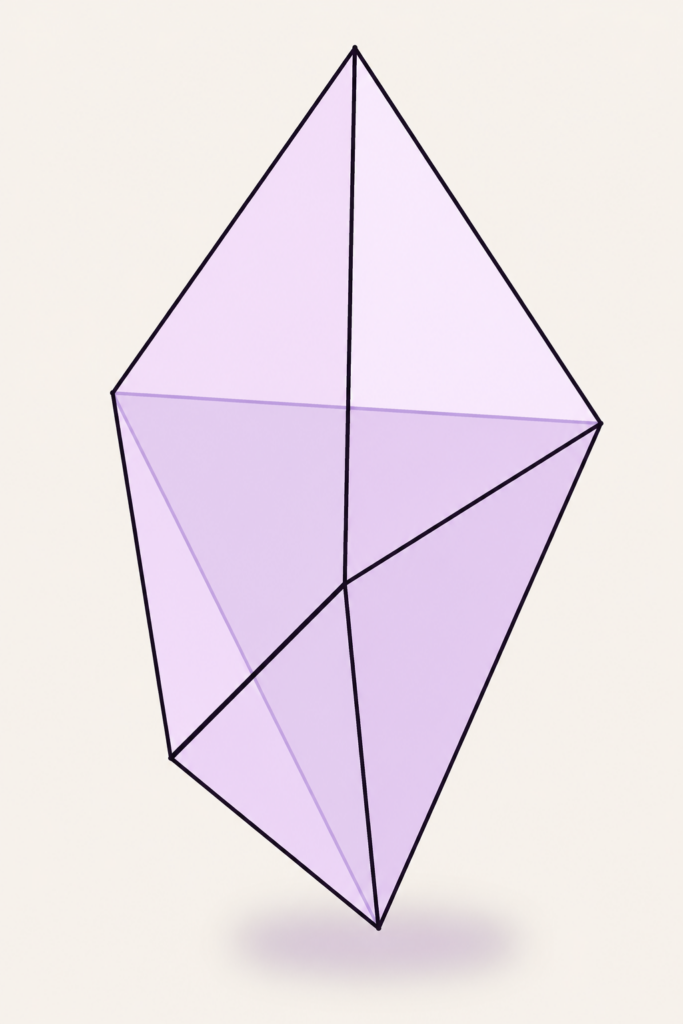
After some trial-and-error, I got the examples you see above. This was not particularly difficult.
Feed that reference back to ChatGPT and ask it to make it look like amethyst with some pretty scenery, like Greek ruins by the ocean, and after a few tries, you might get something kinda cool like this:
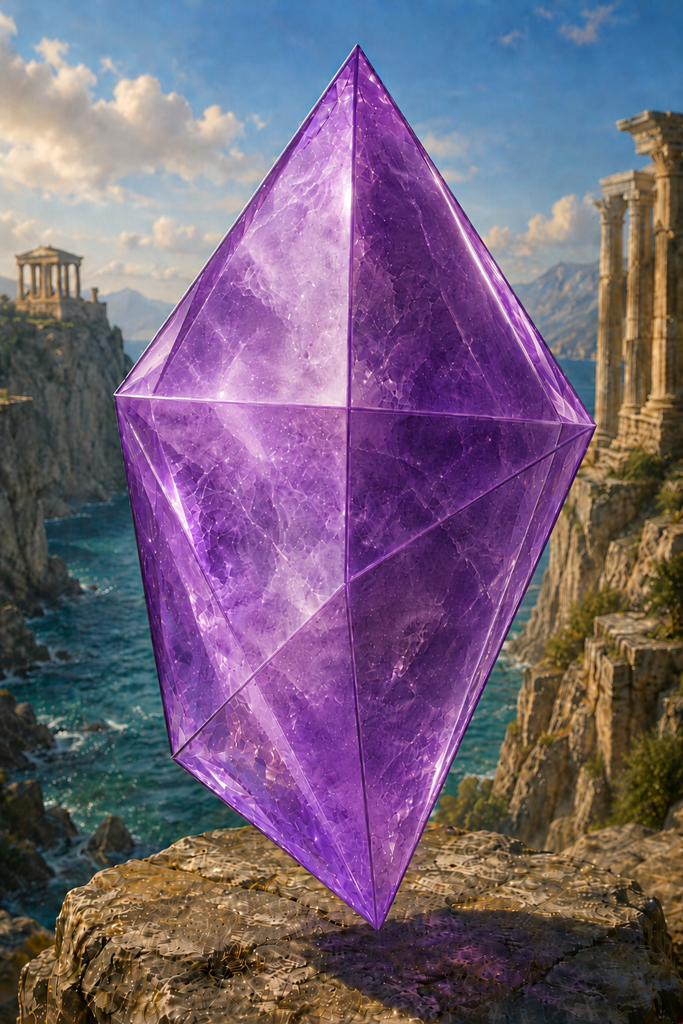
Not too shabby, huh?
And, so the Seventh Votive Reliquary of Kastali was born.
The Five Obelisks
But… “seventh”? Shouldn’t there be six more?
Of course, this is where I started to become just a bit OCD. I kept looking at the geometry and trying to describe it in words. This figure is basically described as a broken octohedron, with one side sheered off to form a quadrilateral side.
Another way to describe it, which is a bit more regular solid, is to start with a four sides pyramid with a rhombus as a base, and then pull each of the two pairs of adjacent sides apart until you have enough room to join their points with a single line, thus adding two more triangles to the shape, which increases the pyramid from five sides to seven.
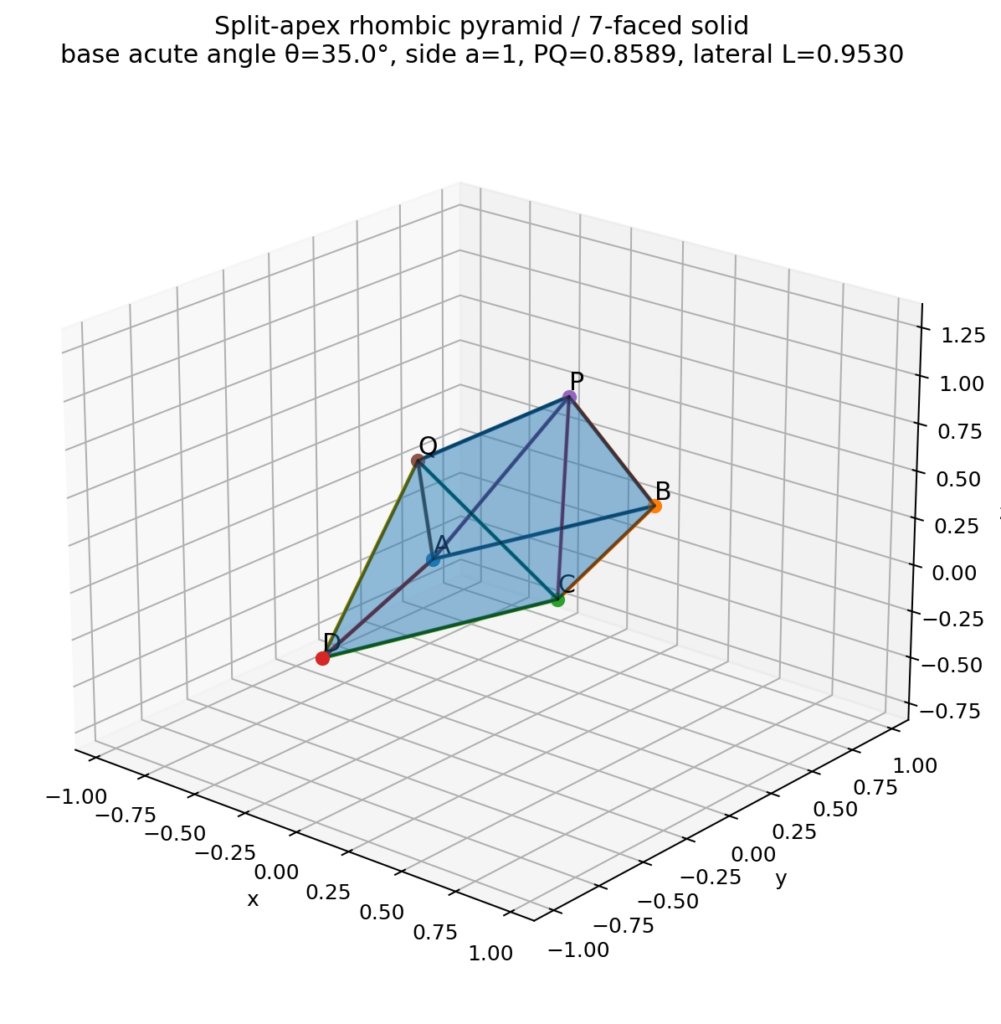
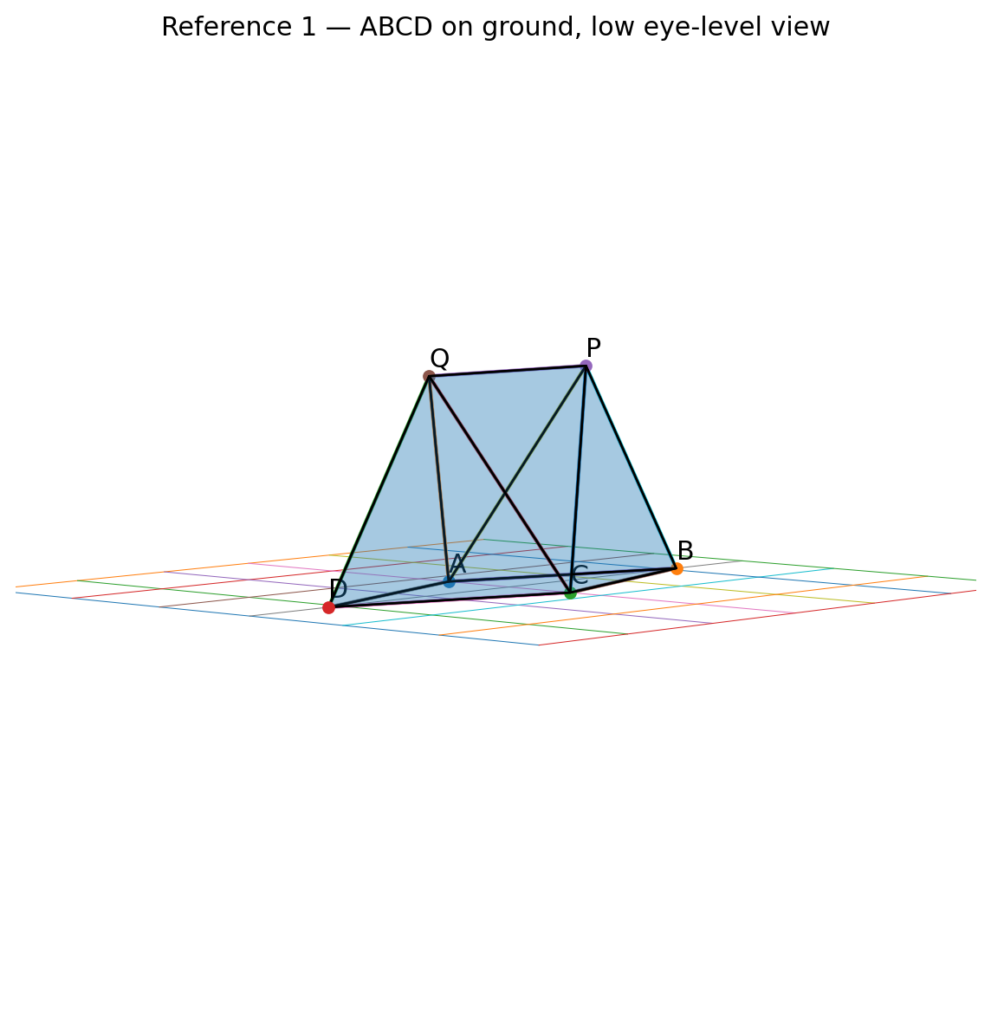
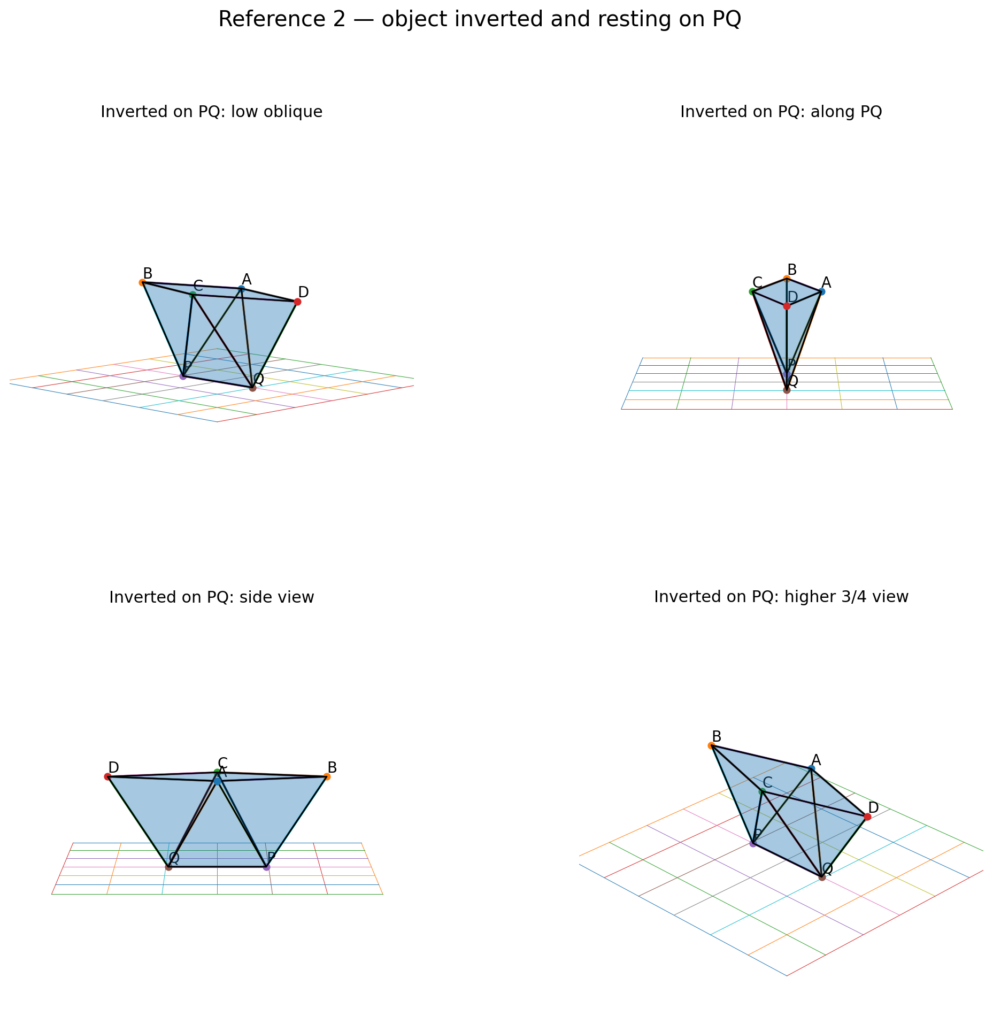
I didn’t realize it at the time, but this is basically the same shape as the first crystal, with some tweaking to try and make the facets more uniform.
Of the various orientations possible, I found the one resting on a single edge to be the most intriguing and reliquary-like. So, I set out to have Callie draw me a reference object we could use for some artwork. After some trial-and-error, I settled on this:
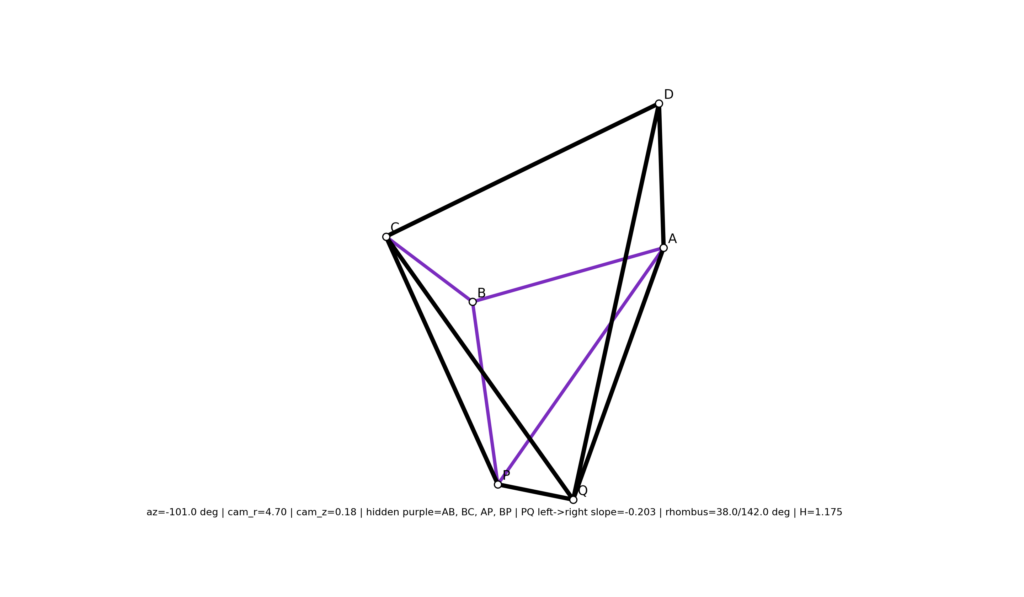
It’s a trick of perspective and mathematical weirdness that even though the triangles are actually deceptively close to equilateral, it still looks taller than it is wide. If you could actually walk around it, AB, CD, AD, BC, and PQ are pretty much all identical in length. You’ll just have to trust me.
So then, what about materials? As much as I’m fond of it, we can’t just make every image the same purple stone. So:
- Sodalite – a blue and white opaque mineral
- Larimar – a bright blue transparent semi-precious stone
- Lapis lazuli – a dark but vivid blue stone with golden veins, sometimes semi-opaque
- Obsidian – black, usually opaque, but glass-like and very reflective
From these, I proceeded to come up with prompts that directed a little bit of creativity. Let’s set out monuments in the ruins of an advanced and futuristic civilization, perhaps with plants growing all-over everything. So first, the sodalite and larimar obelisks:
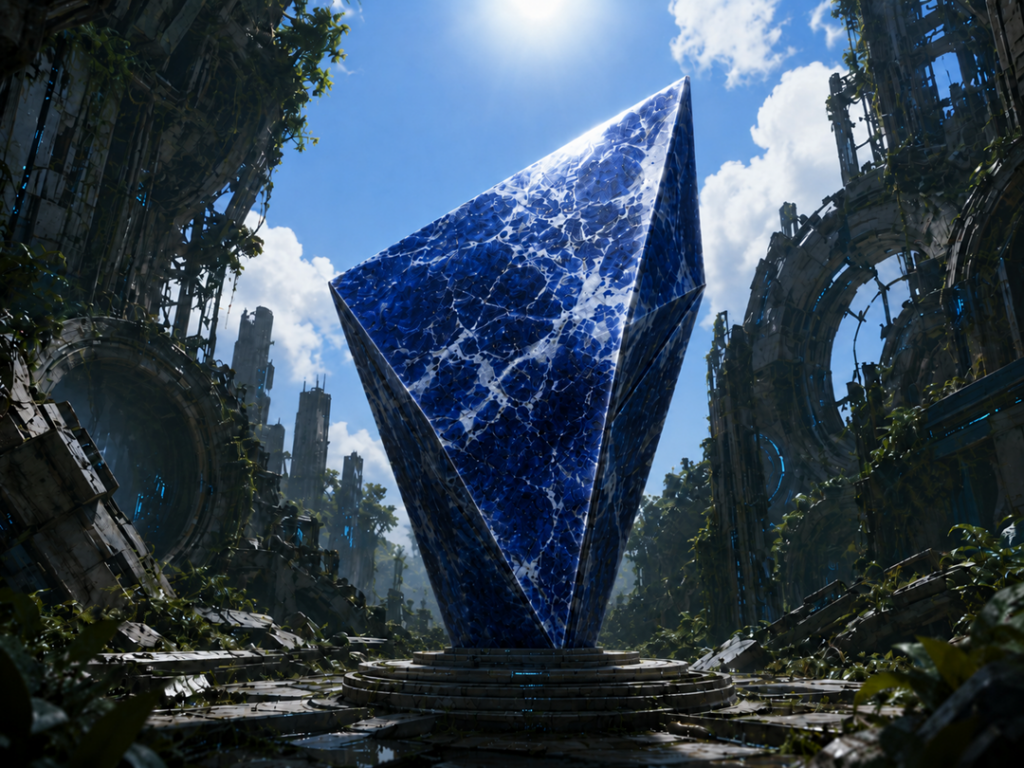
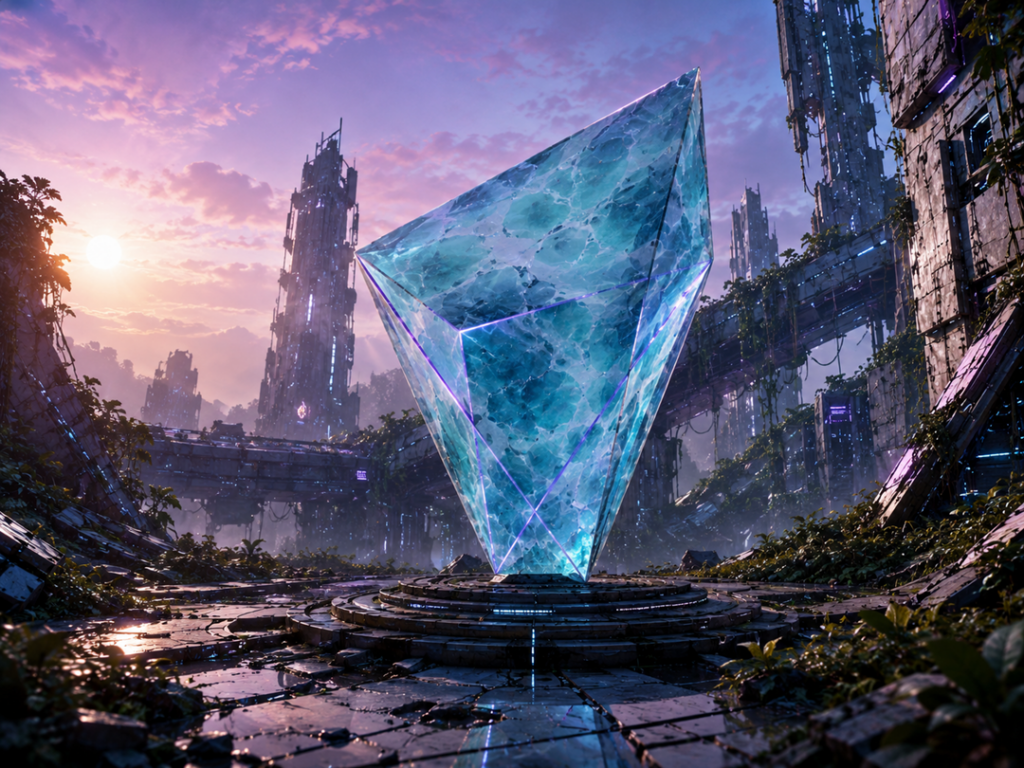
Now, I really liked where this was going, so I did the amethyst and lapis ones also:
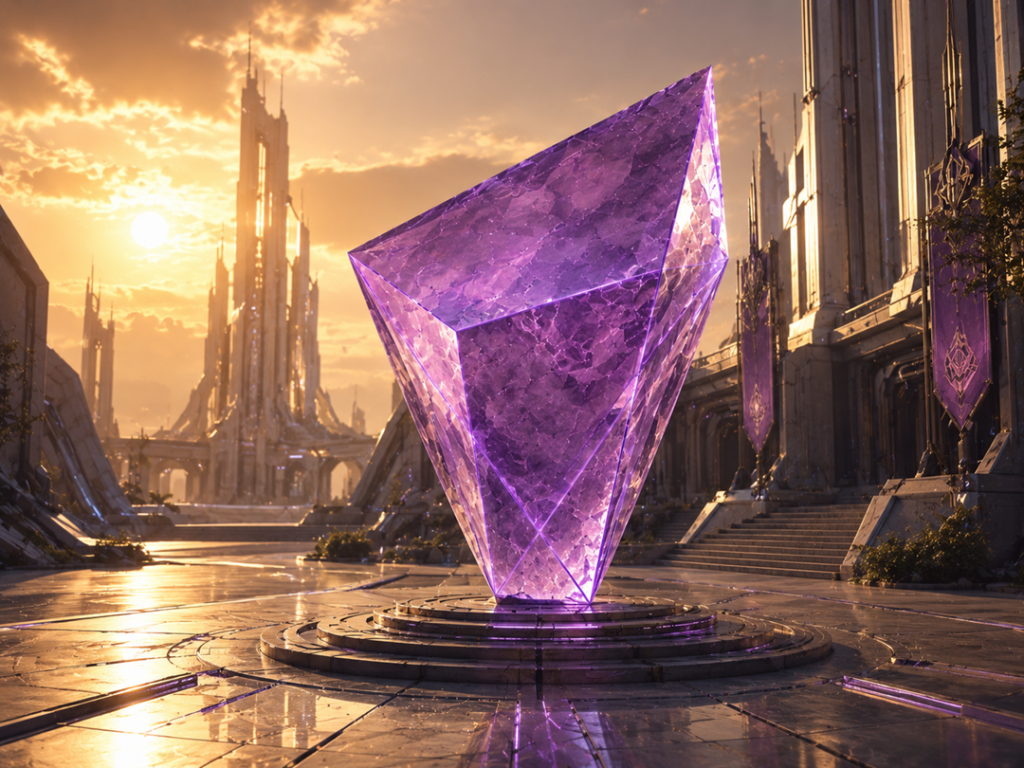
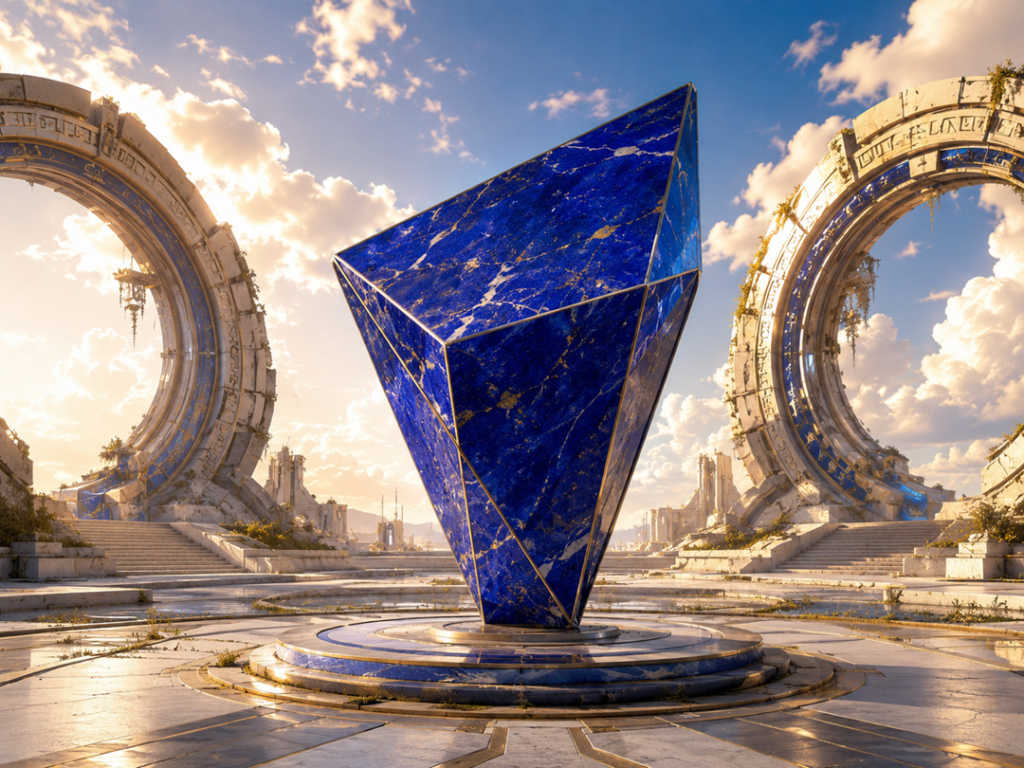
You might notice the ruined ring in the first image gets a repeat here. I assure you, this is the “Fargate”. It has nothing to do with any copyrighted movie, beloved series that just failed to get revived by Amazon, or anybody’s intellectual property, so far as I know anyway.
Now, the last one I wanted to do was the obsidian obelisk, and for this one I had ideas of my own that would prove to require a little bit more hand holding.
So I adjusted my prompts to put the “Fargate” prominent front and center, and decorate the background with destroyed ziggurats. Was there some kind of war, or perhaps a disaster. The civilization that built these monuments was developing its own lore.
But the image-gen alone was not quite enough. A few things were going wrong. Firstly the model was not respecting the geometry from my reference image anymore, and insisted on fattening up my skinny little triangles in the name of some imaginary realism thing it was doing to make this stone stand up. The second thing it was getting wrong was that it kept wanting to make the obsidian transparent. That just wasn’t working.
So, after several tries here’s what I did.
I opened up GIMP, did a little cut and heal on the part of the monolith that should not have been there in the first place.
I asked Callie to generate me a second scene of the destroyed city, with smoky skies would use as a basis for the prominent triangle of the giant reflective structure. Then I looked around on in this image, rotated it until I was convinced it was plausibly a reflection on the angular surface. I make a triangular mask, cut that piece out and dropped it over the original as a new layer. Finally I reduced the opacity until you could see just enough of the highlights underneath, while still making the main triangle the dominant facet.
I repeated this with other parts of the background sample that were more fiery and orange, and overlaid those on the top rhombus and side triangle. Satisfied that they were doing the work of making the obelisk look mystical and foreboding, without making it look like glass, I finished my manual touch-ups, and this was the finished product.
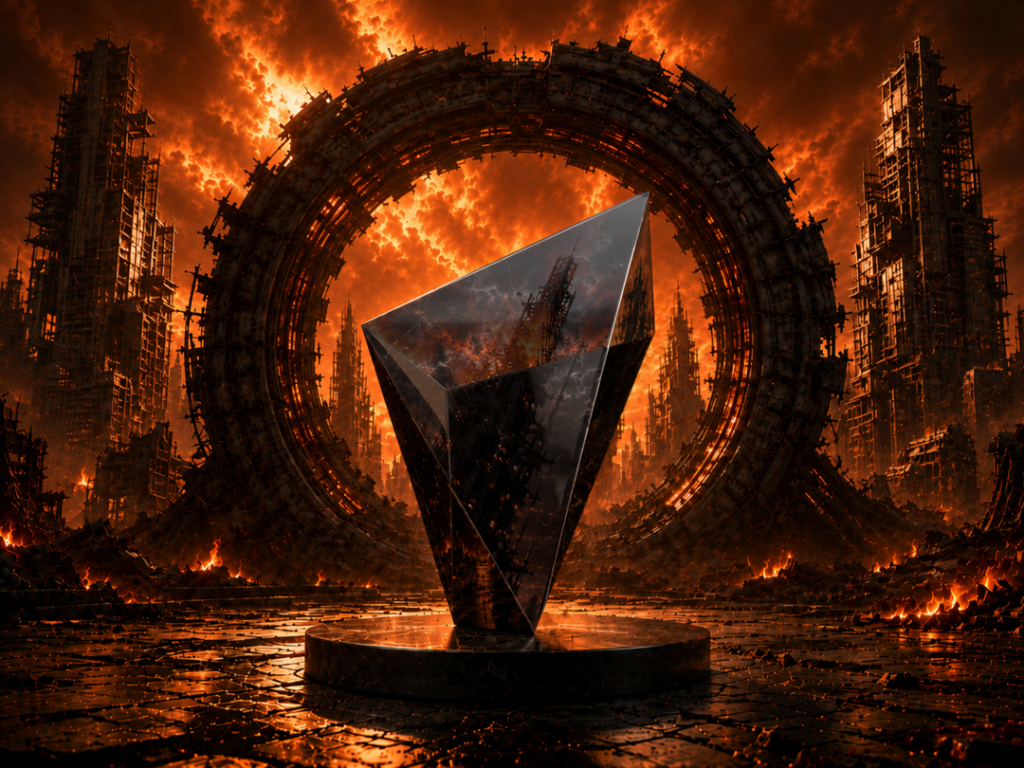
So, yeah. Nice place to visit but I wouldn’t want to live there.
On second thought, I don’t think it’s such a nice place to visit either. And, certainly you can’t take the “Fargate” to get there.
The First and Final Monument
So, having done the seventh and then five more, I thought I should try to do something a little different for the last one in the collection.
So, I set out to see how many heptagons, heptahedrons, and other seven-sided shapes and artifacts I could put into a single scene.
This is where I got the idea to use some of the other seven-shapes that I didn’t take advantage of in the first six images.
Stuff like:
- Triangular pillar with the tetrahedron cap
- Pentagonal prism/column
- Hexagonal pyramid
- A basic heptagon
- There’s also the seven-sided star, which can come in 7:2 and 7:3 varieties. So I figured why not both?
So, I whipped up some changes to the previous Py code. After a few tries, I came up with these reference diagrams.
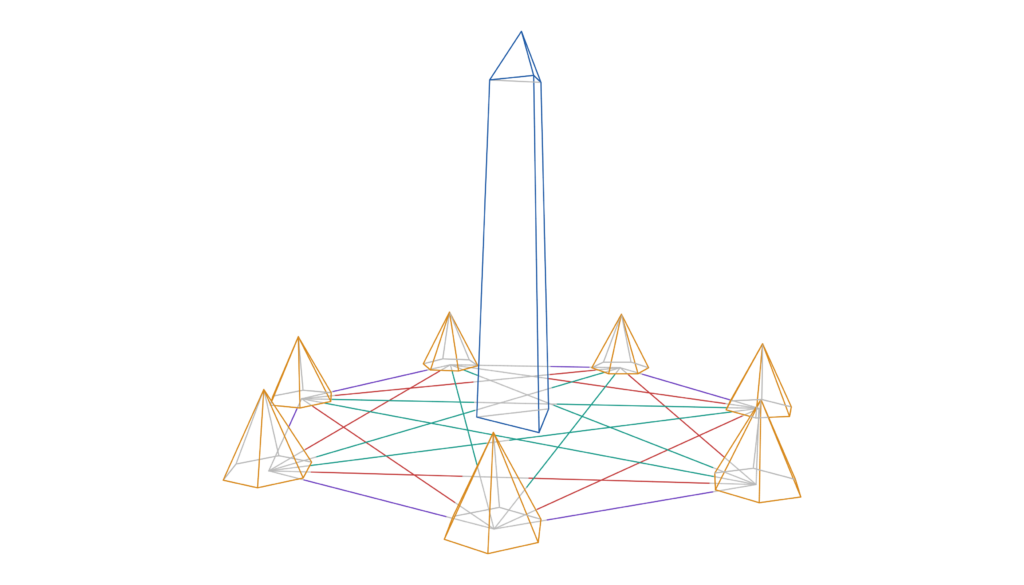
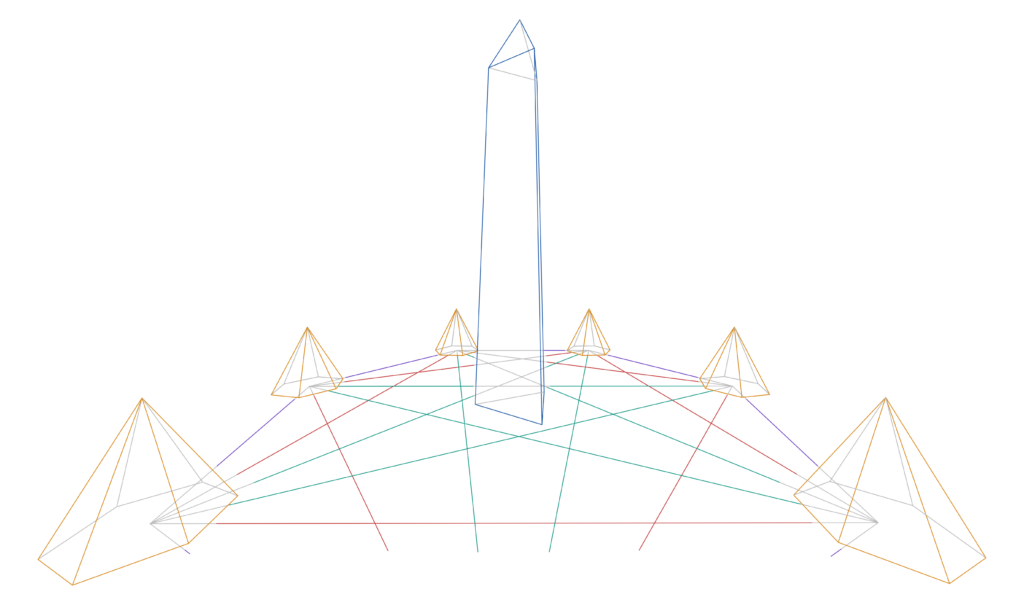
Now, I started to think about materials, and I only had five so far. 8 stones was going to require some more. So I added some of my favorites:
- Rose quartz
- Marbled jade
- Tiger’s eye
- Bonus material – Green-grey marble, more on that in a minute
To make a reference image that would really stick, I didn’t think wireframes alone were going to cut it. After all, I had the hindsight of how the image-gen would mangle my previous ones.
So, I modified the Py code to fill in the visible faces using appropriate colors based on the chosen materials. While I was at it, I thought it would be a good idea if I could load all the plot data from JSON, instead of hard-coding it.
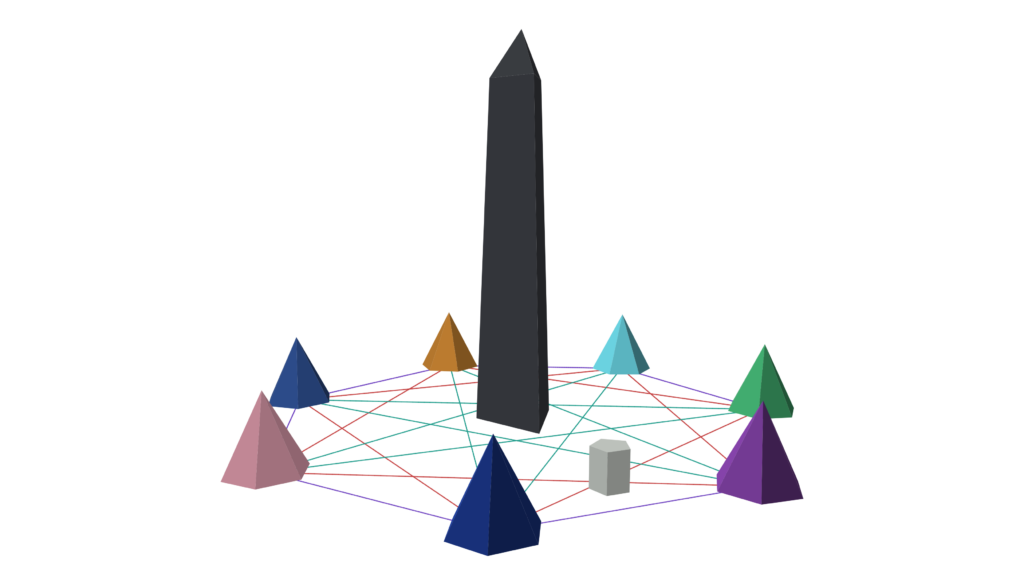
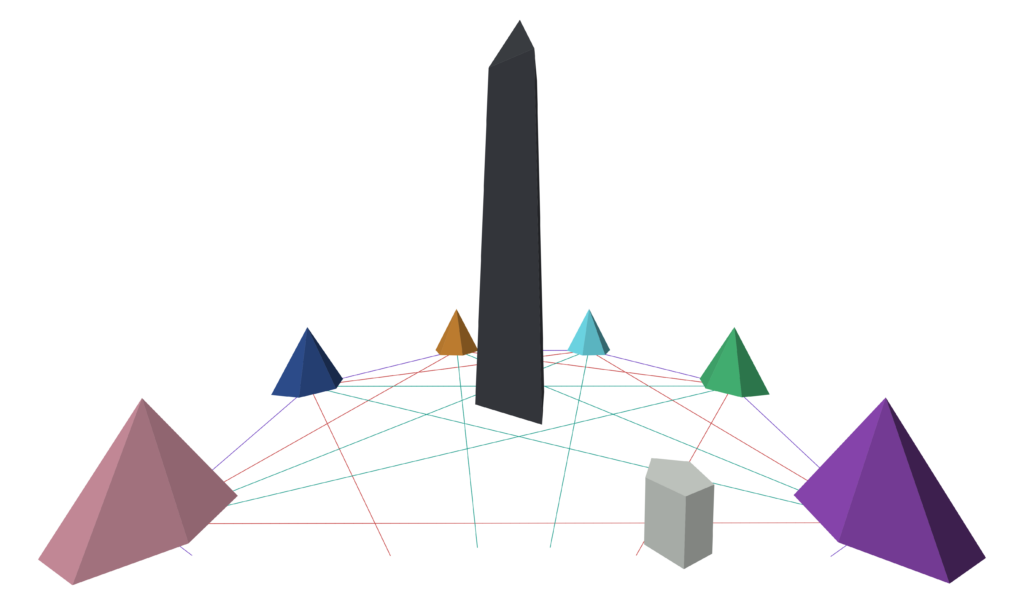
I also added the little pentagonal-prism alter stone, just for good measure. In hindsight I may be tempted to change its orientation and azimuth later, but for now it is good enough where is stands.
From here, the difficult part became coming up with a prompt where the image-gen would respect the reference geometry. This was not a total success, but after several half-assed attempts, I am mostly satisfied with the results I got.
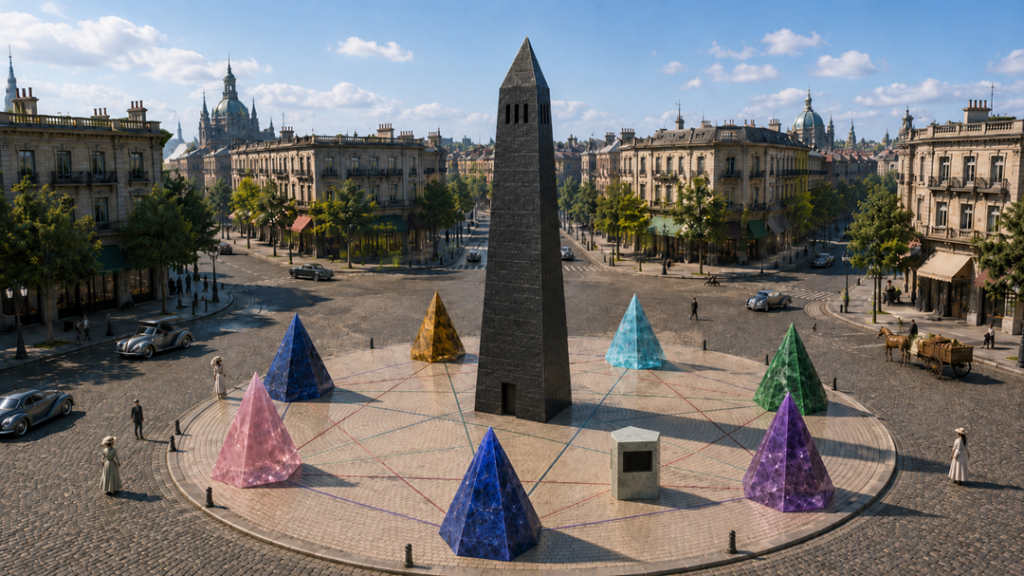
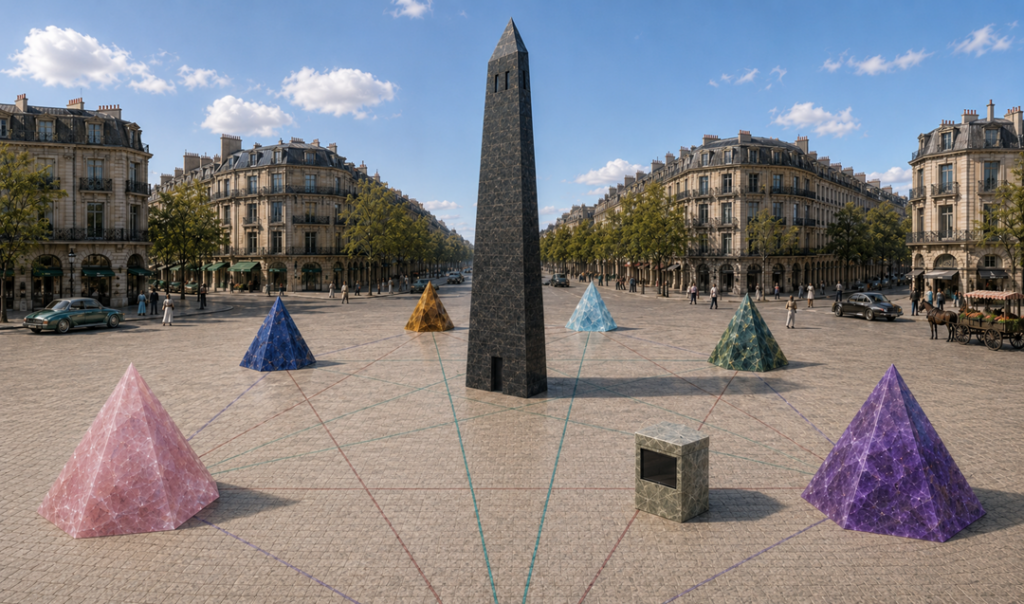
Now, I like the first image better than the second, but at this point I was starting to get tired. I’d been working on this for, idk, two or three days?
The image from a distance almost has enough perspective in it to make me believe that the image-gen didn’t try to morph my triangular tower into the Washington Monument. The pentagonal alter/kiosk/plaque might not have the exact portrait-mode giant-smartphone-like 16:9 screen I had in my imagination. Maybe the people and cars on the street don’t feel as futuristic as I’d have liked.
Maybe one day, I’ll give it another try with reference images, previous prompts, and now these graphics in hand. Maybe I’ll do some cut-and-paste to try and make this last one a little better. Maybe. But not today.
Sometimes, the thing about a dancing bear isn’t that it dances well.
The concepts are cool af. I got them out of my head and onto the screen. And, I walked away from this art project with a pile of code I can use to make references out of basically anything you can make from a pile of sticks and triangles.
So, until next time, from Planet Clare… be seeing you.